
Seed-Strapping: The Founder's Playbook for Scaling Without Surrendering Control
Learn how seed strapping can fuel your startup's growth. Discover practical strategies and insights to navigate this crucial funding stage. Read more!



"In the future, there will be two types of companies: those that use AI and those that have gone extinct."
You’re standing at the edge of a cliff. Behind you lies the comfortable world of traditional business operations. Ahead? The AI-driven future that’s moving faster than a Tesla on Ludicrous Mode. The question isn’t whether you’ll jump—it’s whether you’ll soar or splat.
Artificial intelligence (AI) is now a primary driver of business transformation, reshaping the business landscape and compelling organizations to rethink their operating models.
AI isn’t coming to transform your business. It’s already here, and your competitors are already using it to eat your lunch, steal your customers, and make your business model as relevant as a Blockbuster store. Many organizations rush to adopt AI, driven by fear of missing out or being left behind by competitors. The adoption of AI can transform businesses through efficiencies, enhanced decision-making, and new revenue streams, making it a critical tool for staying competitive.
But here’s the good news: You still have time to get your act together. Now is the time to embrace AI as a strategic imperative for innovation and growth. This guide isn’t another fluffy “AI is magic” fantasy. It’s your war plan for becoming genuinely AI-ready in a world where being “pretty good” at AI is like being “pretty good” at the internet in 1995—not nearly enough. Business leaders must proactively assess their organization’s readiness for adopting AI and lead the change to ensure successful integration. A comprehensive AI readiness assessment can help identify gaps in current capabilities, which might reveal the need for better data management and employee training.
Adopting AI requires significant investment in technology, people, and processes, so organizations must plan strategically to maximize ROI and ensure sustainable growth. It is essential to align AI initiatives with business priorities and business objectives to ensure that every AI project supports the company’s overarching goals and delivers real value.
Before pursuing AI readiness, organizations need to build a solid foundation—robust data, skilled personnel, and mature processes are essential for successful AI adoption and long-term organizational improvement.
Do you think you’re ready for AI because you use ChatGPT for writing emails? That’s like thinking you’re ready for Formula 1 because you can drive to Starbucks. Real AI readiness is a different beast entirely.
AI readiness isn’t about having the latest shiny tools—it’s about having the organizational DNA to absorb, adapt, and amplify intelligence at scale. It’s the difference between being AI-curious and being AI-native. AI integration requires a supportive technology stack that can handle large datasets. As part of assessing readiness, organizations must evaluate both their current and emerging AI technologies to ensure they can support evolving business needs.
| AI-Curious Companies | AI-Native Companies |
|---|---|
| Use AI as a side project | Embed AI in core operations |
| Focus on cost reduction | Focus on value creation |
| Treat AI as IT’s problem | Make AI everyone’s opportunity |
| Copy competitors’ AI moves | Create AI-first strategies |
| Measure AI by inputs | Measure AI by outcomes |
True AI readiness means your organization is prepared to implement AI technology effectively, not just experiment with it. This involves more than acquiring tools; it requires the ability to implement AI across teams, processes, and strategies.
Before you can win the AI game, you need to know where you’re actually playing from. Most executives live in a fantasy where their company is “pretty advanced” with AI. Time for a reality check.
| Assessment Area | Beginner (1-3) | Intermediate (4-6) | Advanced (7-8) | AI-Native (9-10) |
|---|---|---|---|---|
| Data Quality | Siloed, inconsistent data | Clean data in key areas | Enterprise-wide data standards | Real-time, AI-optimized data flows |
| Technical Infrastructure | Legacy systems dominate | Cloud migration in progress; initial adoption of cloud services for scalable AI deployment | Modern, scalable architecture leveraging cloud services to support AI | AI-first infrastructure designed to support AI at scale, with robust cloud services for high-speed processing and storage |
| Team Capabilities | Few AI-literate employees | Dedicated AI team | AI skills across departments; teams prepared to support AI initiatives | AI literacy is table stakes; teams fully equipped to support AI at scale |
| Decision Making | Gut-feel driven | Some data-driven insights | Analytics-informed decisions | AI-augmented decision making |
Here are the questions that will make you squirm—and the ones that matter most:
Forget the 47-slide PowerPoints about “AI transformation.” Your AI strategy should fit on one page and answer the following three key questions:
AI should not drive strategy. Instead, strategy should guide the implementation of AI. A clear strategy ensures successful AI implementation by aligning technical infrastructure, organizational readiness, and financial planning with business objectives. This ensures that AI initiatives align with the organization’s broader goals.
| Business Impact | Implementation Complexity | Priority | Timeline |
|---|---|---|---|
| Customer Service Automation | Low | High | 3-6 months |
| Predictive Analytics | Medium | High | 6-12 months |
| Product Personalization | High | Medium | 12-18 months |
| Supply Chain Optimization | High | Low | 18+ months |
Most companies stop at efficiency. Winners push through to evolution.
Think of AI adoption like learning to drive. First, you’re scared of the parking lot. Then you’re cruising the neighbourhood. As organizations move beyond experimentation, implementing AI requires addressing challenges such as refining business processes and ensuring workflows are mature enough for successful integration. Finally, you’re navigating rush hour traffic like a pro.
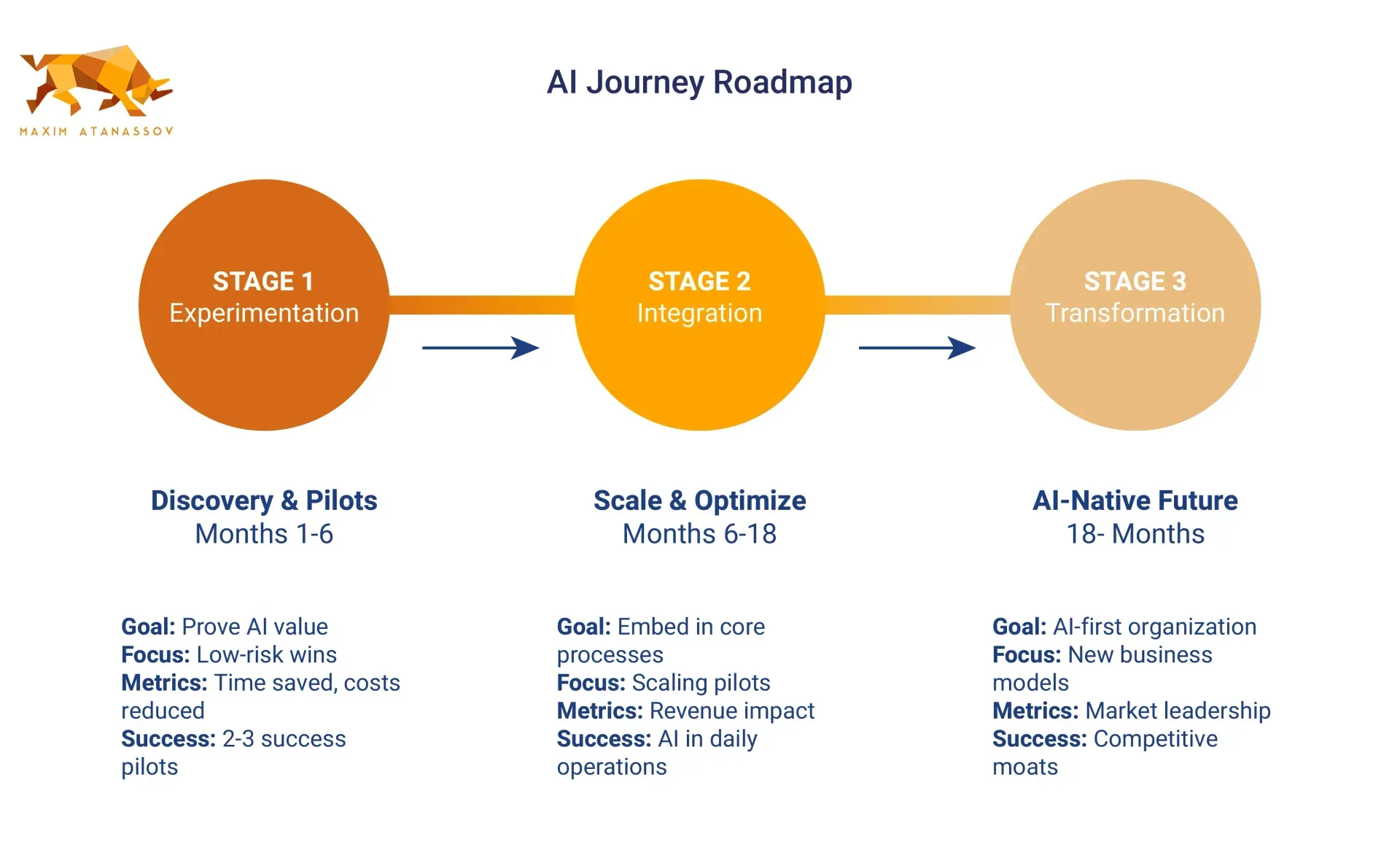
Successful AI integration requires balancing three forces: Technology, Process, and People. Mess up any one, and the whole thing collapses like a house of cards.
| Integration Focus | Technology | Process | People |
|---|---|---|---|
| Infrastructure | Cloud-native, scalable systems | DevOps and MLOps pipelines | Technical talent and training |
| Operations | AI-enabled workflows | Redesigned processes | Change management |
| Governance | Security and compliance | Quality assurance | Ethics and oversight |
Phase 1: Foundation Building
Phase 2: Process Enhancement
Phase 3: Cultural Transformation
Here’s the challenge: You need enough governance to prevent AI disasters, but not so much that you strangle innovation. It’s like being a helicopter parent—too little oversight and your AI goes rogue; too much and it never learns to fly. Data governance policies help maintain the integrity and accessibility of data for AI use. Data accessibility is equally critical to data quality for effective AI governance.
| Governance Layer | Purpose | Key Questions |
|---|---|---|
| Strategic | Align AI with business goals | Does this AI initiative support our strategy? |
| Operational | Ensure AI works as intended | Is our AI performing as expected? |
| Ethical | Maintain trust and fairness | Would we be comfortable if this AI decision was on the front page? |
| Legal | Comply with regulations | Are we meeting all relevant legal requirements? |
Let's be honest about AI ROI: Most companies struggle to measure it effectively. They track easy metrics like "hours saved" while ignoring hard-to-measure benefits like "competitive moats created." Establishing a clear financial strategy for AI helps determine if AI initiatives are viable and ensures resources are allocated effectively.
Think of AI investments like a venture capital portfolio:
70% Safe Bets: Efficiency plays with clear, measurable ROI
20% Strategic Plays: Enhancement initiatives with medium risk/reward
10% Moonshots: Evolutionary projects with high risk/reward
| Investment Type | Time to Value | Risk Level | Strategic Impact | Resource Required |
|---|---|---|---|---|
| Quick Wins | 3-6 months | Low | Medium | Low |
| Core Capabilities | 6-18 months | Medium | High | Medium |
| Game Changers | 18+ months | High | Very High | High |
Measuring AI maturity isn't about counting the number of AI projects you have running (that's like measuring success by how many meetings you attend). It's about measuring how AI is fundamentally changing your business.
| Maturity Level | Data | Technology | People | Strategy |
|---|---|---|---|---|
| Level 1: Aware | Siloed data | Legacy systems | AI curious | No AI strategy |
| Level 2: Experimenting | Some clean data | Cloud migration | AI projects | Tactical AI use |
| Level 3: Systematic | Integrated data | Modern stack | AI skills | AI roadmap |
| Level 4: Transformative | Real-time data | AI-first architecture | AI-native culture | AI-driven strategy |
| Level 5: Innovative | Predictive data | Autonomous systems | AI leadership | AI business models |
Leading Indicators (predict future success):
Lagging Indicators (measure current performance):
Here's what most executives miss: AI readiness isn't primarily a technology challenge—it's a people challenge.
You can have the best AI tools in the world, but if your culture treats them like expensive calculators, you'll get expensive calculator results. Leadership must actively engage with the workforce to address concerns about the role and benefits of AI. Assessing leadership commitment involves actively defining AI's role in the company's long-term strategy.
| Cultural Element | Traditional Mindset | AI-Native Mindset |
|---|---|---|
| Decision Making | Experience + intuition | Data + algorithms + intuition |
| Failure | Avoid at all costs | Fast failure, fast learning |
| Expertise | Knowing the answers | Asking better questions |
| Change | Planned and controlled | Continuous and adaptive |
Your data isn't just supporting your AI—it IS your AI strategy. Companies that figure out how to turn data into a competitive advantage will dominate their markets. Everyone else will become data sharecroppers for the AI giants. Leadership must ensure that AI governance aligns with customer data security laws to establish trust.
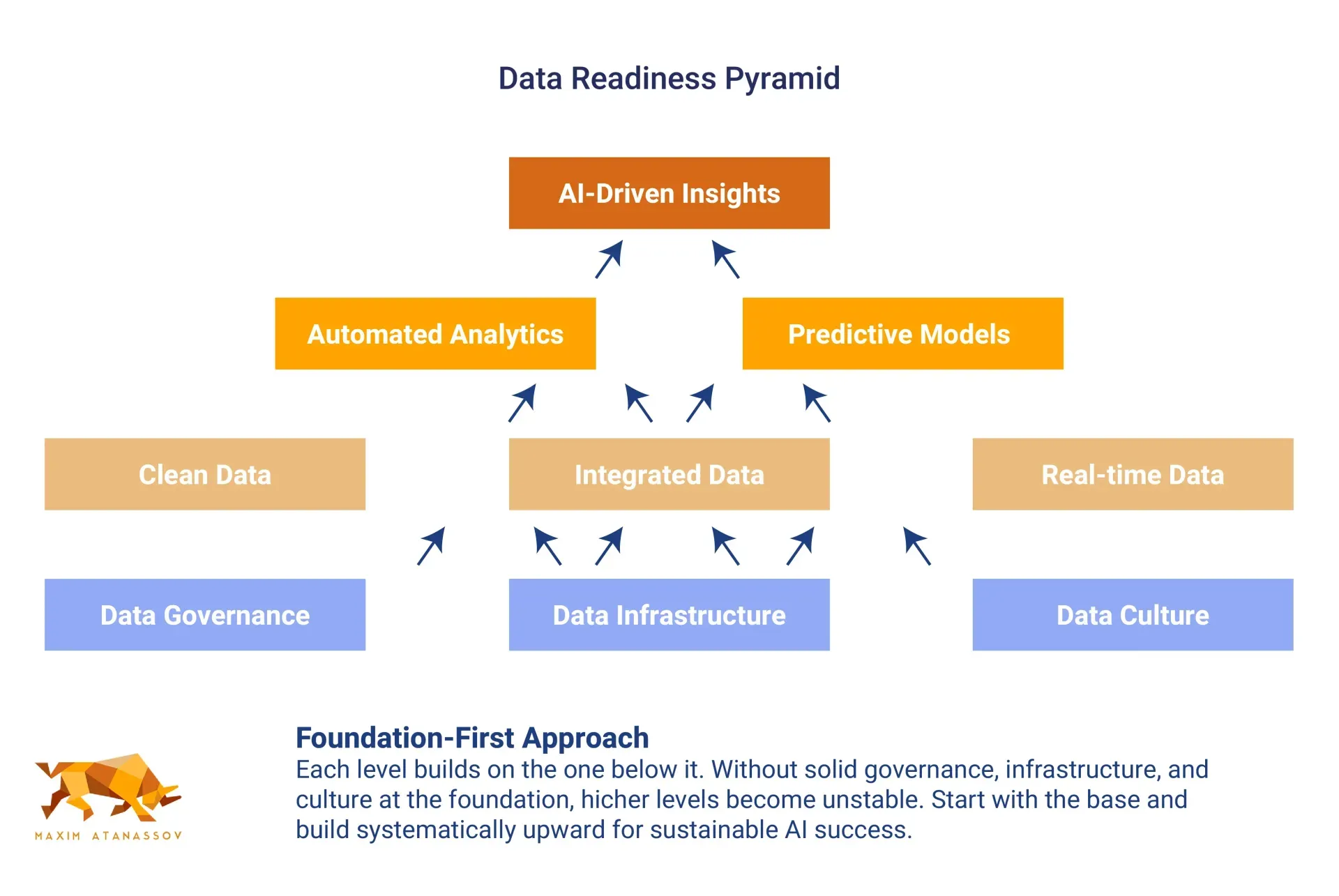
AI doesn't just improve your existing processes—it fundamentally changes what's possible. The companies that figure out how to redesign their operations around AI capabilities will create unbridgeable competitive gaps.
| Process Type | Pre-AI State | AI-Enhanced State | AI-Native State |
|---|---|---|---|
| Customer Service | Reactive support | Predictive assistance | Proactive problem solving |
| Sales | Broadcast outreach | Targeted campaigns | Personalized experiences |
| Operations | Historical reporting | Real-time monitoring | Autonomous optimization |
| Product Development | Feature-driven | User feedback-driven | Predictive market-driven |
Level 1: Automation - Replace human tasks with AI Level 2: Augmentation - Enhance human capabilities with AI Level 3: Transformation - Create entirely new processes enabled by AI
Most companies stop at Level 1. Winners push through to Level 3.
Leading an AI transformation requires you to be simultaneously confident and humble—confident enough to make big bets on uncertain technology, humble enough to admit when you don't know something and learn rapidly.
| Scenario | Traditional Response | AI-Era Response |
|---|---|---|
| Uncertain outcomes | Wait for more data | Run small experiments |
| Technical complexity | Hire consultants | Build internal capability |
| Employee resistance | Mandate adoption | Demonstrate value |
| Competitive pressure | Copy competitors | Create unique advantage |
You have two choices:
Keep doing what you're doing. Use AI for small efficiency gains. Stay comfortable. Watch as AI-native competitors slowly, then suddenly, make your business irrelevant.
Embrace the discomfort. Rebuild your business around AI capabilities. Accept that you'll make mistakes. Create competitive advantages that are impossible to replicate.
Becoming AI-ready isn't a project—it's a commitment to continuous transformation. It's accepting that the moment you think you've "arrived" at AI readiness, you're already behind.
AI readiness isn't about technology—it's about mindset. It's about building an organization that sees every challenge as an opportunity to apply intelligence at scale. It's about creating a culture where humans and AI work together to achieve what neither could accomplish alone. The organizational readiness to leverage AI effectively is as important as the technology itself, requiring alignment across people, processes, and tools.
The companies that master this balance won't just survive the AI revolution—they'll lead it.
The question isn't whether you can afford to become AI-ready.
The question is: Can you afford not to?
The future belongs to the AI-ready. Make sure you're one of them.
Learn how seed strapping can fuel your startup's growth. Discover practical strategies and insights to navigate this crucial funding stage. Read more!
Learn how the Lehman scale sets M&A and capital-raising success fees: the Lehman formula, Double Lehman, modern variations and what founders should negotiate.
Explore the J Curve's implications for investors and strategists, balancing risks and rewards. Gain insights to enhance your decision-making—read more now!
Learn practical strategies to overcome common challenges as a first-time fund manager. Dive into our guide for essential tips and insights. Read more!
MIT found 95% of AI pilots fail. See how companies use AI to improve client workflows — and why integration decides the winners.
Discover how the CEO of the future is transforming business leadership and driving change. Read the article to learn more about this emerging role.
Quality of Earnings (QoE): understand what buyers and investors look for, uncover red flags, and boost valuation before your exit.
Maximize your productivity with our CEO time management template. Learn strategies to structure your day effectively. Read more for practical insights!
How founders use a 90-day execution sprint to turn strategy into results: set quarterly priorities, align the team and keep everyone accountable for progress.
Discover key insights on investor perceptions when founders become defensive. Learn tips to navigate tough conversations effectively. Read the article now!








