Seed-Strapping: The Founder's Playbook for Scaling Without Surrendering Control
Learn how seed strapping can fuel your startup's growth. Discover practical strategies and insights to navigate this crucial funding stage. Read more!



If you’re scaling a company, you’re not just managing cash flow, headcount, and churn. You’re playing a high-stakes game of power. Every board meeting, investor pitch, and competitor move is a negotiation in power dynamics. Ignore that fact and you’ll get out-positioned. Understand it, and you gain an unfair advantage.
Robert Greene’s The 48 Laws of Power is infamous: half manual, half warning label. It’s been embraced by CEOs, generals, rappers, and even inmates, because it distills human behaviour down to raw rules. It is a multi-million-copy bestseller and has been praised by mainstream outlets, including People magazine. Love it or hate it, the book survives because it works. Greene distilled three thousand years of power history into forty-eight essential laws.
The 48 Laws of Power is a self-help book written by Robert Greene that has become synonymous with the pursuit of power, influence and scale. The book has sold over 1.2 million copies in the United States alone and millions more globally.
Greene’s world is feudal courts, silk robes, and Machiavellian plots. You don’t run a 17th-century kingdom. You run a business in 2025. The question is: How do you apply The 48 Laws of Power in today’s boardrooms, venture ecosystems, and hypercompetitive markets without becoming a cartoon villain? Greene draws on historical figures like Machiavelli, Sun Tzu, and Henry Kissinger to illustrate the amoral nature of power.
This guide is your translation. You’ll see how to court attention in an algorithmic world, crush enemies without lawsuits, build fortresses in a cyber age, and turn obstacles into opportunities. Think of this not as a book summary, but as a strategic operating system for power in business.
Power isn’t about titles or corner offices. It’s about leverage over outcomes. The CEO who can’t rally talent, persuade investors, or crush competitors isn’t powerful. Rather, they’re a hostage with a C-suite badge. Reputation is the cornerstone of power.
The 48 Laws begin with a core truth: people are self-interested. They act to protect status, wealth, ego, and survival. When you understand that, you stop being surprised by politics, betrayals, or sudden shifts in loyalty. Instead, you predict them. Understanding manipulation tactics is a key value of the book, allowing readers to demystify and defend against unethical behaviours.
The central premise of the book is that power is an amoral game that is constantly being played. Additionally, the book advises against committing to anyone in order to maintain control over your relationships, ensuring flexibility and leverage in interactions.
Modern Application: Critics find the worldview in the book excessively cynical, suggesting it promotes a relentless quest for power that breeds paranoia.
👉 Key Takeaway: If you’re surprised by betrayal, you weren’t paying attention.
Jeff Bezos applied Greene’s laws like gospel. As one of the powerful figures who has successfully applied these laws, Bezos exemplifies how such principles can be used to dominate entire industries. Publishers underestimated Amazon early on. Bezos courted attention relentlessly (“Earth’s Biggest Bookstore”), created dependency (publishers couldn’t sell without him), then crushed them with data and scale. He didn’t just play the game; he rewrote it.
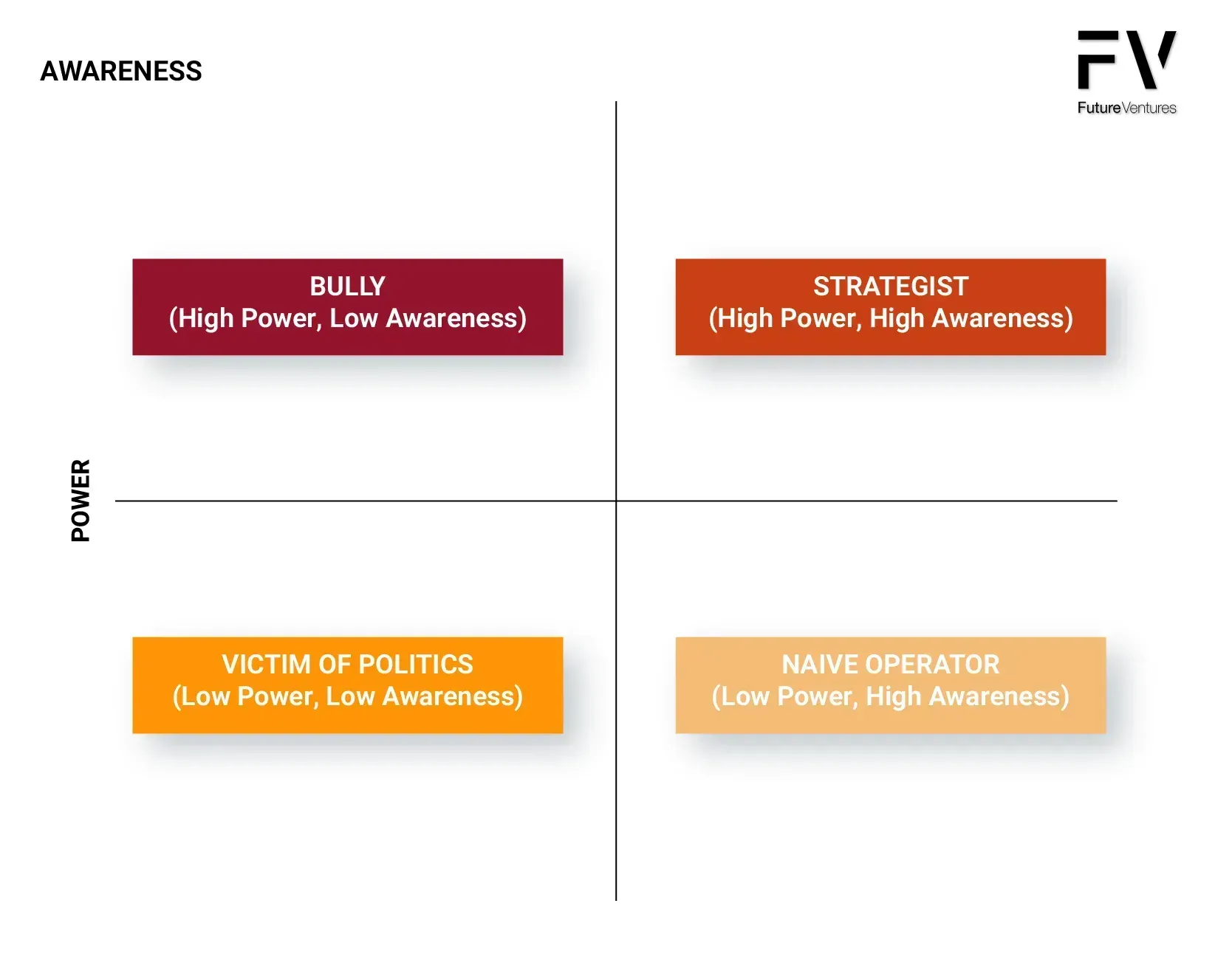
| Axis | Low Awareness | High Awareness |
|---|---|---|
| Low Power | Victim of politics | Naïve operator |
| High Power | Bully, short-lived gains | Strategist, sustainable |
Each quadrant reflects not only your position but also the different powers you can leverage. Whether it's the authority of a strategist or the influence of a bully, your awareness determines how effectively you utilize these powers.
You want to live in the top right: a strategist with power and awareness. That’s where founders who scale to IPOs and industry dominance sit.
In historic times, this meant dazzling courts with jewels. In present times, it’s owning your narrative in a noisy market. Attention is oxygen. Prioritize it at all costs. Lose it and your competitors will suffocate you.
How You Apply This:
Translation: Don’t humiliate your investors, mentors, or bosses. Founders who publicly criticize VCs often find doors closed quietly. Respect hierarchy, even as you climb it. Don't provoke your competitors, unless you are certain that you can beat them at their own game.
Application:
A reputation is compound interest. As Warren Buffett once said, “It takes 20 years to build a reputation and five minutes to ruin it.”
Paying the full price for quality and integrity is essential to maintaining a good reputation and avoiding future problems that shortcuts or hidden costs can cause.
In business, reputation is:
👉 Future Lens: In an AI-filtered world, reputation data will be algorithmically scored. Trust metrics will be displayed alongside credit scores. Guard your reputation like your company’s stock price. It will literally be one.
Sounds medieval, right? But in startup land, half measures breed zombies. If a competitor has 20% of your TAM, they’ll haunt you in every investor pitch.
Modern Example:
How You Apply This:
Never put too much trust in friends, learn how to use enemies. Former enemies often make more loyal allies than friends, because they have more to prove. Enemies can become powerful motivators and strategic assets if you channel the rivalry productively.
Sometimes enemies are your best PR. Steve Jobs vs. Bill Gates made Apple a rebel brand. Netflix vs. Blockbuster fueled Netflix’s underdog story.
Ask yourself: Who’s your Blockbuster? Who's your archnemesis? Who can you define yourself against? When leveraging conflict, always recommend absolute self-preservation as a key strategy. Protect yourself first while using your enemies to fuel your narrative.
| Approach | When to Use | Risk |
|---|---|---|
| Crush | When survival is at stak | Escalates costs, attracts scrutin |
| Leverage | When the enemy makes you look better | May strengthen them indirectly |
| Ignore | When the enemy is an irrelevant distraction | Risk of underestimating them |
👉 Note: The surrender tactic can be used as a strategic option when direct confrontation is too risky. By appearing to yield temporarily, you may gain a psychological edge, frustrate your opponent, and create opportunities to turn perceived weakness into an advantage.
Timidity kills startups. Markets reward decisive moves. Investors don’t back founders who hedge. They back those who say, “We’re going to dominate this category.”
Airbnb launched at the height of the 2008 financial crisis. Bold move. Investors thought renting your couch to strangers was insane. But boldness turned skepticism into curiosity, then inevitability. The book presents compelling examples of boldness leading to success, illustrating how audacious actions can significantly alter the course of events.
Action Steps:
Greene’s warning is timeless: don’t play one move ahead. Chess is lost not by a bad move now, but by not seeing ten moves later. Historical examples demonstrate that leaders like Napoleon, who failed to plan for the Russian winter, suffered devastating losses, whereas others, such as Winston Churchill, succeeded through meticulous, long-term planning.
In scaling companies, this means:
Greene said isolation is dangerous. True. Founders who wall themselves off from feedback, markets, or advisors get blindsided.
However, in 2025, you will need fortresses, such as cybersecurity, data moats, and proprietary AI models. Build those walls high, while staying open to market signals. Even prison inmates have turned to the book for guidance on protecting themselves in challenging environments, showing its relevance for anyone seeking effective self-defence strategies.
Markets change. Power shifts. You must evolve. Think of Netflix: from DVD rentals to streaming to original content to gaming. That’s re-creating yourself.
For You:
Constraints breed innovation. If you don’t have big budgets, you get scrappy. If you’re not a first mover, you learn from their mistakes.
Example: Slack was born out of a failed game startup. The weakness became the product. Transforming weakness into strength can have a lasting impact on people’s lives and careers, shaping their future opportunities and resilience.
Action Step: Audit your “weaknesses.” Ask: If I flipped this on its head, could it be a moat?
Attention spans are short. Data alone won’t win hearts. You need a theatre.
For You:
The pursuit of power, as Robert Greene outlines in his internationally renowned New York Times bestseller, “The 48 Laws of Power,” is often viewed as a zero-sum game. But the real art lies in mastering the paradox: how do you gain ultimate control and transform weakness into strength, without losing your moral compass? Greene’s laws, like “Never Outshine the Master” and “Crush Your Enemy Totally”, may sound ruthless, but they’re rooted in a deep understanding of human nature and the realities of human behaviour in high-stakes environments.
True power isn’t about trampling over others; it’s about reading the room, anticipating moves, and using the laws of power to navigate complex dynamics. The best leaders know when to assert dominance and when to show restraint, turning the 48 laws into a toolkit for both self-defence and strategic advancement. By understanding the motivations behind people’s self-interest, you can avoid being perceived as the wrong person in the eyes of those who matter and instead build a reputation that commands respect.
Ultimately, the 48 Laws teach that power and principle aren’t mutually exclusive. The most effective leaders use the laws to achieve their goals, but do so in a way that aligns with their own belief system. This is how you attain true power: by mastering the game without losing yourself in it.
In the business world, every decision comes with a price. There’s no free lunch. High-stakes leadership means facing ethical dilemmas where the right path isn’t always clear. The key is to understand the laws of power and the nuances of human behaviour, so you can make choices that protect your good reputation while still advancing your cause.
Laws like “Conceal Your Intentions” and “Enter Action with Boldness” aren’t about deception for its own sake. They’re about strategic self-preservation and maximizing the value of time. Great leaders recognize that people rely on them for direction and validation, and that every move is closely scrutinized. By being aware of these dynamics, you can balance your own interests with those of your team, investors, and stakeholders.
The best revenge against ethical ambiguity is clarity: know your values, understand the power strategies at play, and make decisions that you can stand behind. Ultimately, the 48 Laws serve as a definitive guide for navigating the complex and nuanced aspects of leadership. Helping you emerge not just as a powerful figure, but as a respected one.
A compelling vision isn’t just a nice-to-have; it’s a force multiplier for power. People crave direction, meaning and a cause to rally behind. Great leaders, from historical figures to today’s tech icons, use vision to create a deep following and inspire action.
Laws like “Win Through Your Actions, Never Through Argument” and “Play on People’s Need to Believe to Create a Cultlike Following” are about more than persuasion. They’re about building a belief system that others want to be part of. Selective honesty, suspense, and the mirror effect all play a role in making your vision irresistible. When you re-create your own life and business in your own fashion, you invite others to join a movement, not just a company.
The result? A strong following, increased respect, and the ability to transform weakness into strength. Vision gives you ultimate control, not through domination, but through inspiration. The best leaders use the laws of power to craft visions that are both arresting and achievable, turning ordinary teams into genius power game players.
👉 Action Step: Audit your current vision. Does it court attention, create compelling spectacles, and give people a cause worth fighting for? If not, it’s time to re-create it because in the art of power, vision is your most valuable information and your greatest weapon.
The 48 Laws were written for kings and courtiers. But the future will remix them:
So, in addition to adapting his 48, here are the Top 10 “Founder Laws of Power” based on our work with scaling founders. These laws are modern, battle-tested extensions that reflect today’s realities of venture, scale, and digital ecosystems.
In Greene’s day, land was power. Today, it’s data. If your data sits in someone else’s ecosystem (Amazon, Google, Apple), they own your leverage. Founders who build data moats, such as exclusive user insights, proprietary models, and community graphs, don’t just survive; they dictate markets.
👉 Play: Treat every customer interaction as a data transaction. Structure systems to compound insights.
Attention used to be court gossip. Now it’s controlled by feeds, rankings, and algorithms. If you don’t master how your brand is surfaced through SEO, GEO, social, PR, and AI discovery, you will disappear.
👉 Play: Build distribution as obsessively as product. If the algorithm buries you, you don’t exist.
Greene warned against overcommitting. In scale-ups, optionality is your hedge against chaos. Investors will try to box you in (“this is the only path to IPO”), but you need multiple exit ramps: acquisition, roll-up, IPO, sustainable private empire.
👉 Play: Build at least two future narratives simultaneously. Don’t be captive to a single story.
Your ownership structure is your kingdom. Founders who lose control early, through aggressive dilution or “dumb money,” often find themselves as employees of their own company.
👉 Play: Treat every fundraising like a war strategy. Understand liquidation preferences, voting rights and dilution like generals understand terrain.
Scaling isn’t a sprint; it’s a marathon with landmines. Burnout kills more founders than competitors. Greene never mentioned sleep cycles, but in 2025, mental and physical stamina are non-negotiable power levers.
👉 Play: Guard your energy like your cap table. Time-block recovery. Protect decision-quality.
Founders who build ecosystems (e.g., platforms, APIs, communities) become indispensable. Stripe didn’t just build payments; they built developer power. OpenAI didn’t just ship models; they built an ecosystem of plugins, APIs, and distribution.
👉 Play: Ask: How do I become infrastructure, not just a product?
Power isn’t tested in peacetime. It’s tested in layoffs, failed launches, or scandals. Greene described keeping people in a state of suspended terror; you must keep them in a state of suspended confidence.
👉 Play: Run fire drills. Rehearse crisis comms. In chaos, the calmest leader becomes the most powerful.
Greene thrived on concealment. But in the hyper-connected age, concealment often backfires. Selective radical transparency with teams, markets, and even investors builds disproportionate trust.
👉 Play: Default to openness where others hide. It disarms critics and accelerates loyalty.
Greene wrote about cults of personality. Today, culture is the modern cult. A strong culture multiplies execution, attracts talent, and insulates against crisis.
👉 Play: Codify values early. Scale them intentionally. Treat culture as an asset on the balance sheet.
Your personal reputation as a founder is the company’s most fragile, leveraged asset. Greene saw power in impersonality. Today, founder identity is inextricably linked to a company's brand. Think Musk, Bezos, Whitney Wolfe Herd.
👉 Play: Curate your digital footprint, media presence, and thought leadership like you curate your financials. It compounds.
The 48 Laws of Power aren’t morality tales. They’re X-rays of human behaviour. Ignore them and you’ll be manipulated. Use them, and you’ll scale not just a company, but also your influence. Critics argue that adhering to the book’s principles would lead to unhealthy relationships and a superficial form of power.
As a founder or CEO, power isn’t optional. It’s the currency of scaling. The point isn’t to become Machiavelli in a hoodie. It’s to translate timeless laws into today’s scaling playbook.
War historians have praised the book for its insights into strategy and power, highlighting its relevance not only in business but also in the study of conflict and leadership.
Ultimately, business is a game of power. And those who master the rules don’t just play it; they redefine it.
👉 Action: Download the 48 Laws of Power for Scale-up Founders, including law interpretations and actionable strategies for each law.
Learn how seed strapping can fuel your startup's growth. Discover practical strategies and insights to navigate this crucial funding stage. Read more!
Learn how the Lehman scale sets M&A and capital-raising success fees: the Lehman formula, Double Lehman, modern variations and what founders should negotiate.
Explore the J Curve's implications for investors and strategists, balancing risks and rewards. Gain insights to enhance your decision-making—read more now!
Learn practical strategies to overcome common challenges as a first-time fund manager. Dive into our guide for essential tips and insights. Read more!
MIT found 95% of AI pilots fail. See how companies use AI to improve client workflows — and why integration decides the winners.
Discover how the CEO of the future is transforming business leadership and driving change. Read the article to learn more about this emerging role.
Quality of Earnings (QoE): understand what buyers and investors look for, uncover red flags, and boost valuation before your exit.
Maximize your productivity with our CEO time management template. Learn strategies to structure your day effectively. Read more for practical insights!
How founders use a 90-day execution sprint to turn strategy into results: set quarterly priorities, align the team and keep everyone accountable for progress.
Discover key insights on investor perceptions when founders become defensive. Learn tips to navigate tough conversations effectively. Read the article now!