
Seed-Strapping: The Founder's Playbook for Scaling Without Surrendering Control
Learn how seed strapping can fuel your startup's growth. Discover practical strategies and insights to navigate this crucial funding stage. Read more!



Scaled business growth isn’t a linear race—it’s a survival game where the rules change faster than TikTok trends. The difference between scaling and dying often comes down to ruthless prioritization, talent density, and avoiding what I call “scale-up vertigo” (more on that later). Let’s break this down like a profit-and-loss statement.
Well-defined strategies are critical in achieving growth and reaching scaleup status. These strategies should encompass clear goals, focus areas, and measurable actions, distinguishing effective planning from vague aspirations.
The 3 Phases of Scale-Up Pain:
Companies that scale up successfully are able to adapt to changing market conditions and stay ahead of the competition.
Key Metric: If your CAC payback period grows faster than your revenue, sound the alarms.
Building a strong foundation is the bedrock of a successful scale-up. Think of it as constructing a skyscraper; without a solid base, the entire structure is at risk of collapsing. Business leaders must start by establishing a clear vision, mission, and set of core values that will guide every decision and action within the company. This clarity not only aligns the whole team but also sets the stage for exponential growth.
A well-defined strategy is essential for achieving this growth. Enter the One Page Strategic Plan (OPSP)—a powerful tool that distills your winning strategy into a concise, actionable format. This is your Business Model Canvas. This plan ensures that everyone in the company is on the same page, driving towards the same goals. Many start-ups falter in their scale-up journey due to a lack of planning, poor execution, and inadequate support systems. By contrast, a strong foundation, built on a deep understanding of the company’s strengths, weaknesses, opportunities, and threats (SWOT analysis), can set the stage for success.
Moreover, a strong company culture is indispensable. It attracts and retains top talent, drives innovation, and fosters a sense of belonging and purpose. Business leaders must be adaptable and willing to pivot when necessary, as the scale-up journey is often unpredictable and fraught with challenges. By laying a strong foundation, business leaders can set their companies up for long-term success and achieve their growth goals.
Forget 50-page decks. If your strategy doesn’t fit on a page, you’ve already failed. Why? A one-page strategic plan or business canvas can help you, as the business leaders, clarify your vision and goals and communicate them to the whole team. Everyone in the chain of command has to be absolutely clear on the North Star and the strategy that the company is pursuing. A good strategy should be focused on the core values and mission of the company and should be aligned with the company’s overall vision. A good indicator that your scaling-up strategy is on point is when you start saying ‘No’ more than you are saying ‘Yes.’
The Scale-Up Strategy Matrix
| Element | Startups (< $10M) | Scale-ups (>$10M) |
|---|---|---|
| Focus | Product obsession | Process obsession |
| Risk Tolerance | High (gambler mindset) | Calculated (chess master) |
| Hiring Priority | General athletes | Specialist ninjas |
| Cash Burn | Acceptable | Existential threat |
Example: Slack’s pivot from gaming to SaaS was a strategic neutron bomb—they kept the chat tech that worked and torched the rest. The product that they had developed internally to help them communicate better became the Product around which the company organized.
Scaling up isn’t about doing more—it’s about doing better in four non-negotiable areas. Borrowed from Verne Harnish’s battle-tested framework, these pillars separate the rocketships from the wreckage:
| Pillar | Focus | Key Actions |
|---|---|---|
| People | Talent density + culture | Hire A-players, build accountability, kill ego-driven politics and get rid of yes-sayers |
| Strategy | Ruthless prioritization | Create a one-page plan, dominate a niche, say “no” to shiny objects |
| Execution | Daily rhythm of accountability | Implement OKRs, daily huddles, and RACI matrices |
| Cash | Oxygen for growth | Track burn rate like a hawk, negotiate 90-day terms, diversify funding |
Companies that have successfully scaled up by focusing on these four pillars have significantly contributed to economic growth and job creation.
The Scaling Up method is Verne Harnish’s playbook for turning growth from chaotic to systematic. Think of it as business judo—using momentum to scale without imploding.
A key component of this method is the implementation of well-defined strategies that transform chaotic growth into systematic growth.
1.Decisions (The “What”)
2.Disciplines (The “How”)
3.Catalyst (The “Who”)
| Revenue Phase | Focus | Killer Risk |
|---|---|---|
| $0-$10M | Product obsession | Running out of cash (82% fail here) |
| $10M-$100M | Process obsession | Founder’s ego vs. systems |
| $100M+ | Culture carrier | Innovation complacency (RIP Blockbuster) |
⚠️ Warning: Scaling Up ≠ scaling fast. It’s scaling right—the method forces you to sweat the 20% that drives 80% of results.
Integration Tip: Weave these pillars into your existing strategy like Tesla’s Autopilot—always on, course-correcting in real time.
Exponential growth isn’t luck—it’s physics. Exponential growth is a key characteristic of successful scale-ups. Business leaders should focus on achieving exponential growth by identifying and leveraging key drivers of growth. Companies that have scaled successfully often focus on these key drivers to increase their size and impact significantly.
Do you have an Opportunites Management Framework in place? Have you defined all of your Drivers and Improvement Levers in an Enterprise Value Map?
Do you have a Capital Allocation framework that prioritizes the areas of highest growth potential?
⚠️ Warning: If your responses to the previous questions are not a resounding “Absolutely!”, it might be time to seek assistance.
CTA: We invite you to a no-obligation consultation to explore how we can collaboratively create a Growth and Value Drivers Assessment.
Companies that achieve exponential growth can stay ahead of the competition and attain long-term success. This also involves the systematic identification of new markets, the development of new products and services, and the establishment of strategic partnerships.
Scale-ups die from distraction, not competition.
| High Impact | Low Impact | |
|---|---|---|
| Low Effort | Do immediately | Delegate/automate |
| High Effort | Schedule deep work blocks | Eliminate ruthlessly |
Pro Tip: If it doesn’t move ARR or NPS, it’s a hobby—not a priority.
The CEO’s role evolves faster than a TikTok dance trend:
| High Potential | Low Potential | |
|---|---|---|
| High Performers | Future executives (invest heavily) | Plateaued stars (manage out) |
| Low Performers | Growth projects | Immediate exits |
Case Study: Microsoft’s “growth mindset” overhaul under Satya Nadella added $1T in market cap.
RACI Matrix for Scale-Ups
| Role | Responsibility |
|---|---|
| Responsible | The Navy SEALs executing the mission |
| Accountable | The president who loses sleep over nukes |
| Consulted | The advisors who’ve seen this movie beforendice |
| Informed | Everyone else (keep updates concise) |
Data Point: Companies using OKRs (like Google) grow 3x faster than those relying on vague KPIs.
Scaling up a business is not without its challenges, and business leaders should be aware of the common obstacles that they may face. This includes managing cash flow, navigating different geographies, and staying ahead of the competition. Companies that are able to overcome these challenges are able to achieve their goals and stay ahead of the competition. Scaling requires strong communication, regular schedules, meetings, and checkups.
Additionally, well-defined strategies are crucial in overcoming these challenges, as they provide clear goals, focus areas, and measurable actions that align with the company’s vision and mission.
| Strengths | Weaknesses |
|---|---|
| First-mover advantage | Technical debt |
| Opportunities | Threats |
| Emerging markets | Regulatory shifts |
Measuring and evaluating progress is the compass that guides a successful scale-up. Without it, business leaders are navigating in the dark. The Scale-Up Scorecard is an invaluable tool for tracking performance, identifying areas for improvement, and making data-driven decisions that propel the company forward.
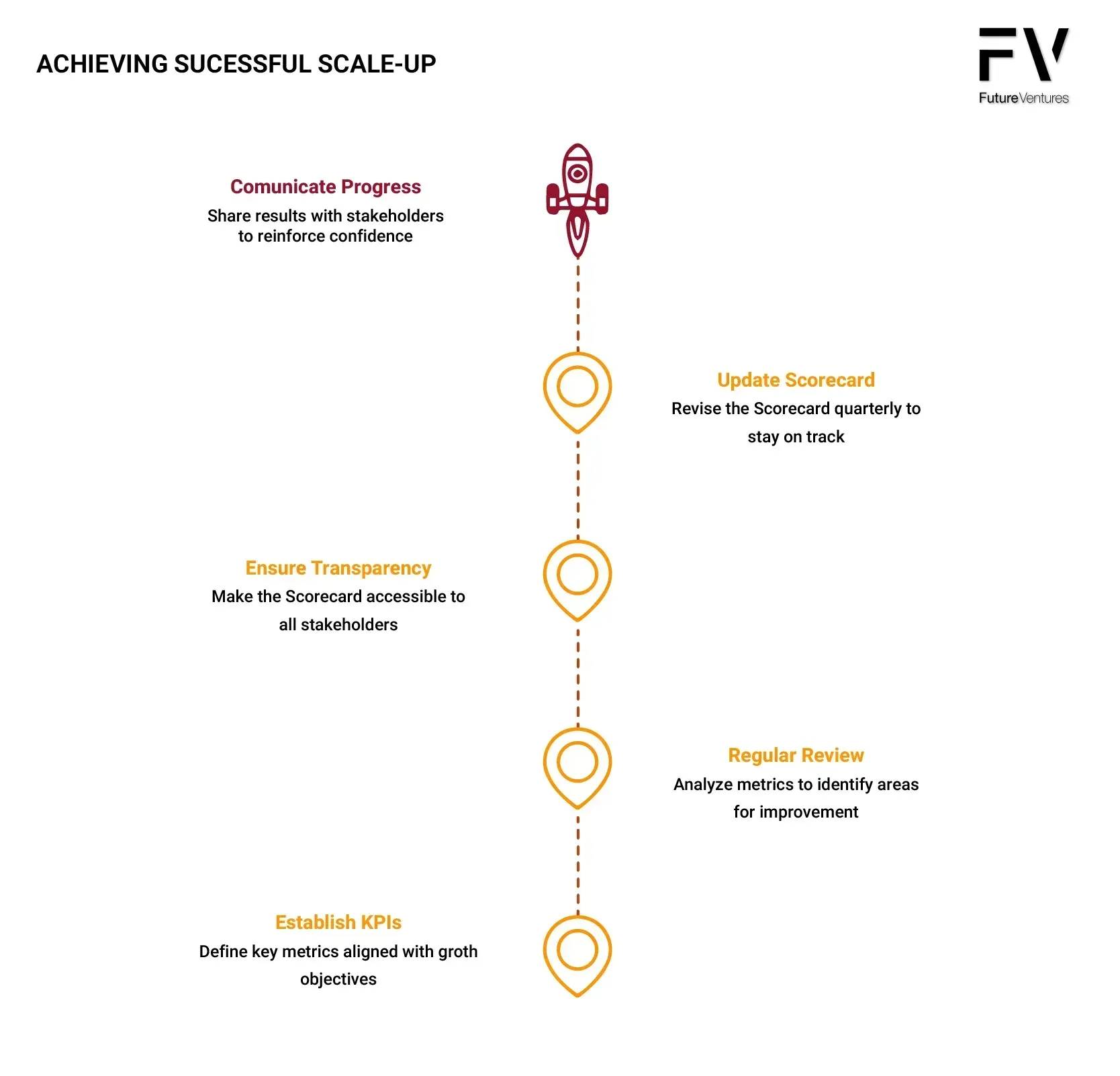
To start, business leaders must establish clear key performance indicators (KPIs) and metrics that align with their growth objectives. These might include revenue growth, customer acquisition, customer retention, and employee engagement. Regularly reviewing and analyzing these metrics allows leaders to pinpoint what’s working and what needs adjustment.
Transparency and accountability are crucial. The Scale-Up Scorecard should be accessible to all stakeholders, ensuring everyone understands the company’s progress and challenges. This openness fosters a culture of trust and collective responsibility.
The Scorecard should be reviewed and updated regularly, ideally on a quarterly basis. This ensures that the company remains on track to achieve its growth goals and can quickly adapt to any changes in the market or internal dynamics. By using the Scale-Up Scorecard, business leaders can make informed decisions, drive growth, and achieve success.
Moreover, the Scorecard is a powerful communication tool. It provides a clear snapshot of progress and results to investors, customers, and employees, reinforcing confidence and commitment. By measuring and evaluating progress regularly, business leaders can ensure their companies are on the path to a successful scale-up, navigating the complexities of growth with precision and confidence.
Sustainable scale isn’t about being the biggest—it’s about being indispensable. Companies that have scaled successfully to become category kings, like Amazon and Google, demonstrate the importance of this approach.
The 3 Laws of Category Kings:
Scaling is 10% strategy, 90% execution. The companies that win are those where every employee can recite the playbook blindfolded—but still improvise like jazz musicians when the market shifts. Your move!
Learn how seed strapping can fuel your startup's growth. Discover practical strategies and insights to navigate this crucial funding stage. Read more!
Learn how the Lehman scale sets M&A and capital-raising success fees: the Lehman formula, Double Lehman, modern variations and what founders should negotiate.
Explore the J Curve's implications for investors and strategists, balancing risks and rewards. Gain insights to enhance your decision-making—read more now!
Learn practical strategies to overcome common challenges as a first-time fund manager. Dive into our guide for essential tips and insights. Read more!
MIT found 95% of AI pilots fail. See how companies use AI to improve client workflows — and why integration decides the winners.
Discover how the CEO of the future is transforming business leadership and driving change. Read the article to learn more about this emerging role.
Quality of Earnings (QoE): understand what buyers and investors look for, uncover red flags, and boost valuation before your exit.
Maximize your productivity with our CEO time management template. Learn strategies to structure your day effectively. Read more for practical insights!
How founders use a 90-day execution sprint to turn strategy into results: set quarterly priorities, align the team and keep everyone accountable for progress.
Discover key insights on investor perceptions when founders become defensive. Learn tips to navigate tough conversations effectively. Read the article now!








