Seed-Strapping: The Founder's Playbook for Scaling Without Surrendering Control
Learn how seed strapping can fuel your startup's growth. Discover practical strategies and insights to navigate this crucial funding stage. Read more!



In a world where businesses face an ever-expanding universe of threats, your organization’s approach to risk management isn’t just a compliance checkbox—it’s a competitive advantage.
Enterprise Risk Management (ERM) dashboards have evolved from glorified spreadsheets into sophisticated command centers that separate market leaders from the also-rans.
The most effective organizations don’t just survive disruption; they anticipate it, quantify it, and transform potential catastrophes into strategic opportunities.
This comprehensive guide will revolutionize how you visualize, prioritize, and capitalize on risk in your organization, providing a clearer understanding of risk exposure and enabling improved decision-making.
Enterprise Risk Management isn’t just another corporate buzzword to add to your collection. It’s a strategic discipline that fundamentally changes how organizations identify, assess, and address uncertainties across multiple departments. Unlike traditional siloed approaches where each department builds its own risk fiefdom, ERM creates a holistic, portfolio view of significant risks affecting your entire enterprise.
ERM is a structured, consistent, and continuous process for identifying, assessing, responding to, and reporting on opportunities and threats affecting the achievement of organizational objectives. It represents a shift from the reactive “wait until something breaks” model to a proactive approach where risks are anticipated and managed strategically.
Optimizing risk management strategies is crucial in ERM as it helps organizations assess and compare resources, understand the risk-reward tradeoff, and enhance efficiency while maintaining a strong risk posture.
The objective is simple yet powerful: develop a top-down, enterprise view of all significant risks that might impact strategic objectives. Think of it as the difference between looking at individual trees (traditional risk management) versus surveying the entire forest (ERM). Tools like the bowtie platform provide an organization-wide overview of all risks and related information, ensuring a comprehensive understanding of the risk landscape.
As described by NC State’s ERM Initiative, “An effective ERM process should be an important strategic tool for leaders of the business. Insights about risks emerging from the ERM process should be an important input to the organization’s strategic plan.”
This integrated approach allows organizations to:
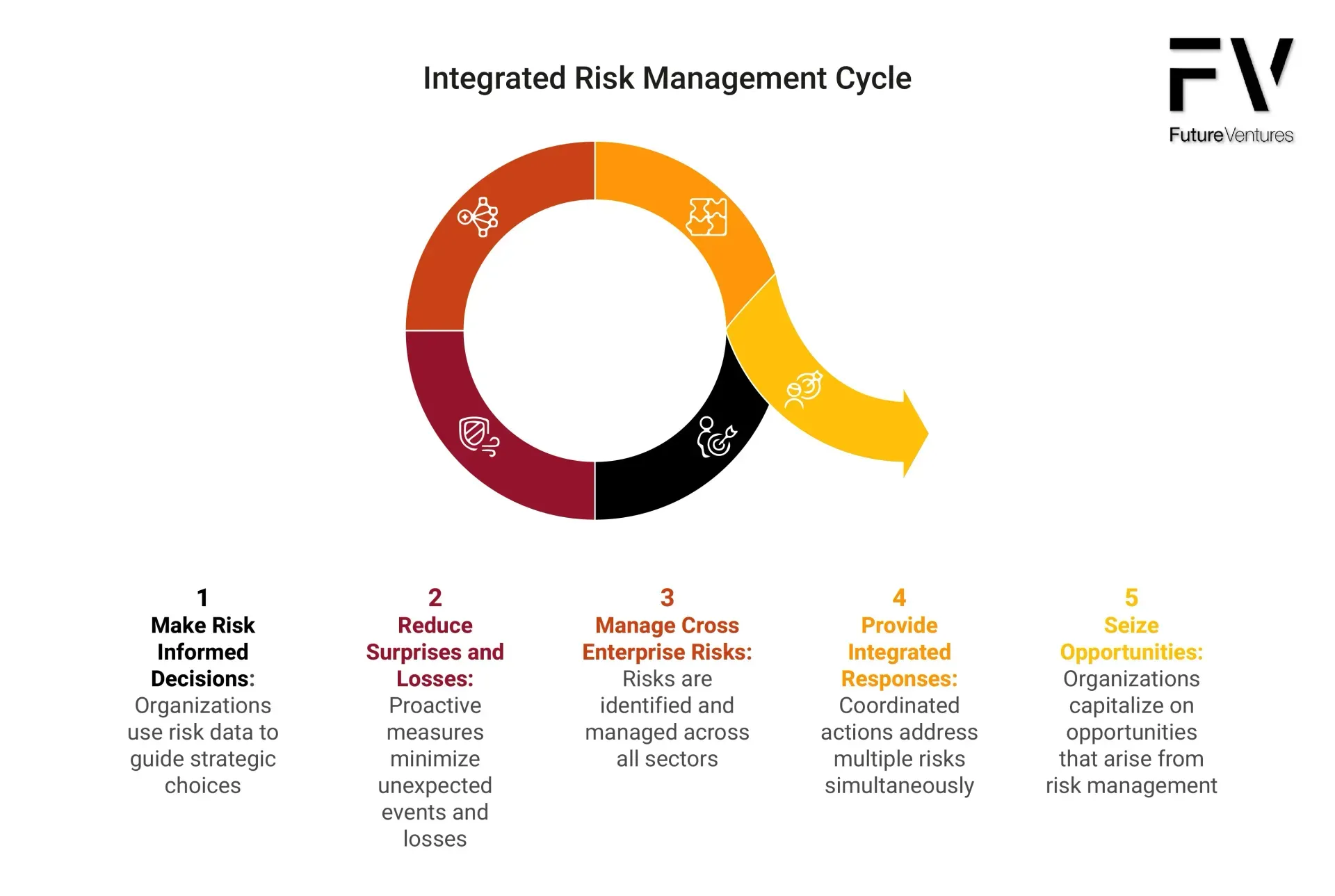
The most effective ERM programs don’t just help organizations avoid bad outcomes—they actively enable good things to happen by improving decision-making in the face of uncertainty.
Organizations implementing robust ERM systems realize significant benefits that extend far beyond regulatory compliance. These advantages directly impact both operational efficiency and strategic positioning.
The ERM process follows a systematic approach that creates a continuous cycle of improvement. While frameworks may vary slightly, most follow these key steps:
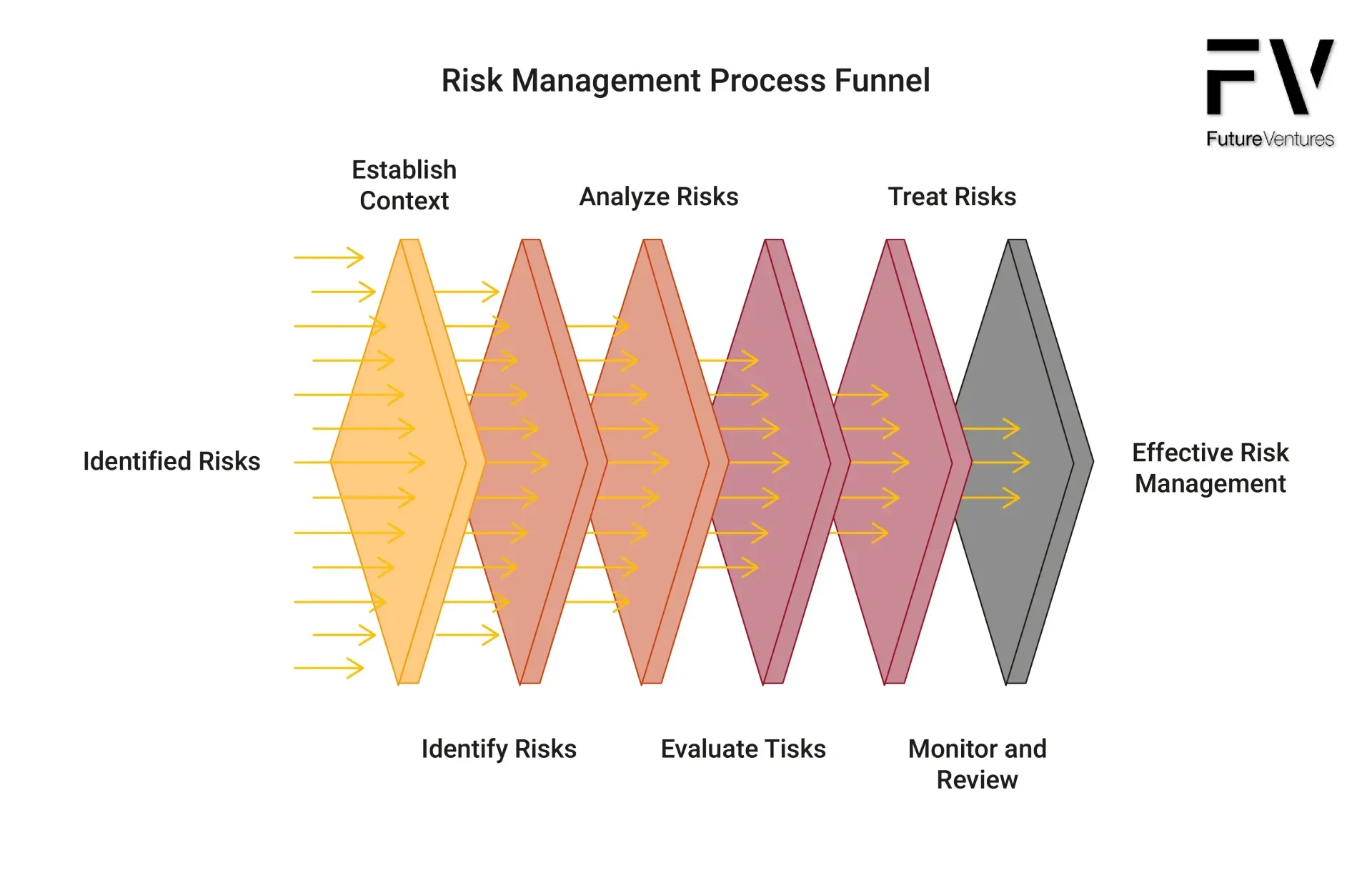
Effective ERM isn't a one-time exercise but rather a continuous cycle that becomes embedded in an organization's strategic and operational processes.
A risk management dashboard transforms abstract risk concepts into visual, actionable intelligence. It’s where the rubber meets the road—translating complex risk data into clear signals that drive decision-making. Risk Management Dashboards display high-level KPIs and insights to communicate risk programs’ overall health, ensuring that stakeholders can quickly grasp the status and effectiveness of risk initiatives.
Risk committees play a crucial role in using these dashboards for effective strategic decision-making. They enable risk committees, along with Chief Risk Officers and Board Members, to monitor metrics, assess enterprise risk management, and facilitate proactive risk strategies to enhance corporate governance and resource allocation.
Key Risk Indicators (KRIs) are the vital signs of your organization's risk health—metrics that provide early warning signals of increasing risk exposure across various business areas. Unlike lagging indicators that tell you what has already happened, effective KRIs are forward-looking metrics that alert you to potential problems before they materialize.
KRIs typically fall into several categories:
Essential KRIs that should be included in any risk management dashboard include:
Effective KRIs aren't static—they evolve as your business and the risk landscape change. The process for developing KRIs typically involves working with subject matter experts to identify metrics, setting appropriate thresholds, and determining the relative weight or importance of each indicator.
A powerful risk management dashboard doesn't exist in isolation—it thrives on connections to diverse data sources throughout your enterprise. Integration capabilities determine how comprehensive your risk visibility will be.
Successful integration encompasses:
As noted in one MetricStream case study, effective integration enabled a Fortune 500 company to replace "time-consuming and labor-intensive" manual processes with automated reporting that consolidated investigative risk information. This integration provided "the ability to track risk profiles, control ownership, assessment plans, and remediation status on graphical charts."
ERM, further streamlining risk management processes. Organizations can also rapidly deploy and collaborate anywhere on risk and control assessments using Protecht. ERM, enhancing flexibility and efficiency.
Risk information needs vary dramatically across an organization. Board members require strategic risk overviews, while operational managers need detailed, function-specific risk data. Effective dashboards accommodate these diverse needs through customization.
Essential customization features include:
This level of customization ensures that each stakeholder receives precisely the risk information they need.
Dashboard design isn't just about aesthetics—it's about creating an interface that communicates complex risk information clearly and drives appropriate action. Poor design leads to confusion, missed signals, and ultimately, ineffective risk management.
Creating an effective risk management dashboard requires balancing comprehensive risk coverage with usability. Following these design principles will ensure your dashboard delivers maximum value:
A well-designed dashboard should tell a story at a glance while allowing users to explore the details behind that story when needed.
The way you visualize risk data significantly impacts how quickly and accurately users can interpret it. Different visualization techniques serve different purposes:
According to UXPin, "Use appropriate visualizations, such as bar charts for comparisons and line charts for trends, to present data effectively." The right visualization makes complex risk relationships immediately apparent, enabling faster and better decision-making.
The consequence vs. likelihood matrix (also called a risk matrix or heat map) is the cornerstone of risk prioritization. It provides a systematic approach to determining which risks deserve immediate attention and which can be monitored less intensively.
A typical risk matrix uses a 5×5 grid with likelihood on one axis and impact (consequence) on the other. The matrix helps visualize and prioritize risks based on both dimensions:
Likelihood Scale (typically 1-5):
Impact Scale (typically 1-5):
The risk rating is calculated by multiplying likelihood by impact: Likelihood × Impact = Risk Rating.
For example, a risk with likelihood 4 (Probable) and impact 5 (Catastrophic) would have a risk rating of 20, indicating a high-priority risk requiring immediate attention.
When using this approach, remember that "the selected likelihood score relates to the likelihood of a particular consequence level actually occurring, NOT just the likelihood of the activity/event/management occurring." This crucial distinction ensures you're assessing true risk rather than just the probability of an event happening.
Risk assessment is the foundation of effective ERM. Without a structured approach to identifying and analyzing risks, even the most sophisticated dashboard will fail to deliver value.
Risk assessments serve as the radar system of your organization—scanning the horizon for potential threats and opportunities that could affect your strategic objectives. They provide the raw material that feeds your risk management dashboard.
The risk assessment process is valuable because it:
The assessment process is often iterative, with each cycle refining the organization's understanding of its risk landscape and improving its ability to identify emerging risks.
A risk heat map transforms abstract risk assessments into a visual format that immediately communicates which risks deserve attention. Creating an effective heat map involves several key steps:
Color-coding the matrix (typically red for high risks, yellow for medium risks, and green for low risks) enhances its visual impact and makes priorities immediately apparent.
When creating a risk heat map, remember that "it is vital to ensure that when choosing the combination of consequence and likelihood that the selected likelihood score relates to the likelihood of a particular consequence level actually occurring, NOT just the likelihood of the activity/event/management occurring"
Risk assessments aren’t just compliance exercises—they drive concrete actions and inform strategic decisions throughout the organization. Effective risk assessments inform:
Risk mitigation strategies play a crucial role in enhancing organizational resilience by refining these processes through granular insights gained from comparing specific assessments.
The most mature organizations integrate risk assessments directly into their decision-making processes, ensuring that risk considerations become part of everyday business operations rather than a separate activity.
Implementation determines whether your risk management dashboard becomes a valuable strategic tool or an unused corporate artifact. Successful implementation requires careful planning and a focus on both technical and human factors.
The right dashboard solution can transform risk management from a periodic exercise into a continuous, value-adding process. When evaluating options, prioritize these essential features:
According to Gartner, "By 2025, 50% of global midmarket and large enterprises will depend on risk management solutions to aggregate digital risks in their business's ecosystem." Choosing a solution with the right features is crucial for future-proofing your risk management capabilities.
Even the most sophisticated dashboard is useless if people don't use it. Successful implementation requires a thoughtful change management approach:
As noted in the Journal of Risk Research, "The success of ERM implementation depends on how well it is integrated into the organization's culture." Change management isn't just about technology adoption—it's about shifting organizational mindsets to embrace a more proactive, data-driven approach to risk.
A well-implemented risk management dashboard delivers tangible benefits that extend far beyond regulatory compliance, transforming how organizations understand and manage uncertainty.
Risk management dashboards serve as the central nervous system for organizational risk, dramatically enhancing visibility across the enterprise:
According to McKinsey, organizations with advanced risk management capabilities are "23% more likely than others to say they are better than competitors at both reducing risk events and seizing risk opportunities."
Risk management dashboards don't just highlight problems—they empower better decision-making at all levels:
Beyond improving decision quality, risk management dashboards drive operational efficiencies:
A study by Aon found that organizations with mature risk management practices experienced 18% less stock price volatility. This stability isn't just about avoiding downside—it's about creating a more efficient, resilient organization capable of seizing opportunities in uncertain environments.
Real-world examples illustrate the transformative power of well-implemented risk management dashboards across various industries.
A leading global bank implemented an enterprise-wide risk management dashboard as part of a broader risk transformation initiative. Key outcomes included:
The bank's Chief Risk Officer noted, "Our new risk dashboard has moved us from reactive firefighting to proactive risk management. We're not just avoiding problems—we're identifying opportunities faster than our competitors."
A major automotive manufacturer implemented a risk management dashboard focused on supply chain vulnerabilities. Results included:
The VP of Supply Chain commented, "Our dashboard gives us x-ray vision into our entire supply network. We can now spot potential issues months in advance and take corrective action before they impact production."
A large hospital network deployed a risk management dashboard focused on patient safety and clinical risk. Outcomes included:
The Chief Medical Officer stated, "Our dashboard has created a culture of safety awareness. Every staff member now has the tools to identify and escalate potential risks before they harm patients."
A rapidly growing software company implemented a risk management dashboard with a focus on cybersecurity and data protection risks. Results included: * 50% reduction in time to detect and respond to potential security breaches * 30% decrease in successful phishing attacks through improved risk awareness * $5 million in avoided costs from prevented data breaches * Competitive advantage in enterprise sales due to demonstrable risk management capabilities Keeper's Risk Management Dashboard provides comprehensive security posture information covering end-user deployment and event monitoring, ensuring organizations can maintain robust defenses against evolving threats.
The Chief Information Security Officer noted, "Our dashboard doesn't just help us avoid breaches—it's become a key differentiator in our sales process. Customers trust us because they can see how seriously we take risk management."
These case studies demonstrate that effective risk management dashboards deliver quantifiable benefits across diverse industries and risk types. The common thread is a shift from reactive to proactive risk management, enabling organizations to navigate uncertainty with greater confidence and agility.
Implementing a risk management dashboard isn't without obstacles. Recognizing and addressing common challenges is crucial for success.
Challenge: Many organizations struggle with siloed, inconsistent data across different systems, making it difficult to create a unified view of risk.
Solution:
Challenge: Employees may resist new risk management processes, viewing them as additional bureaucracy or a threat to established ways of working.
Solution:
Challenge: In an attempt to be comprehensive, organizations sometimes create overly complex dashboards that overwhelm users with information.
Solution:
Challenge: Without strong executive support, risk management initiatives can be underfunded and underutilized.
Solution:
Challenge: Risk environments change rapidly, and dashboards can quickly become outdated if not regularly maintained.
Solution:
By proactively addressing these challenges, organizations can significantly increase the likelihood of successful implementation and long-term value creation from their risk management dashboards.
The risk management landscape is evolving rapidly, driven by technological advancements and changing business environments. Forward-thinking organizations are already exploring these emerging trends:
AI and ML are revolutionizing risk management, enabling:
According to Deloitte, "By 2025, it is expected that AI will be used by 95% of Fortune 500 companies in their risk management operations."
Future risk management dashboards will increasingly incorporate external data to provide broader context:
While still in early stages, quantum computing holds immense potential for risk management:
AR and VR technologies could transform how organizations visualize and interact with risk data:
Blockchain has the potential to enhance several aspects of risk management:
As these technologies mature, risk management dashboards will evolve from passive monitoring tools into active decision support systems that not only highlight risks but also suggest optimal responses and automatically execute certain risk mitigation actions.
Organizations that stay ahead of these trends and integrate emerging technologies into their risk management practices will be better positioned to navigate the increasingly complex and interconnected risk landscape of the future.
In an era defined by volatility, uncertainty, complexity, and ambiguity, effective risk management isn't just a defensive play—it's a strategic imperative that can drive competitive advantage. The risk management dashboard serves as the nerve center of this strategic capability, transforming abstract threats and opportunities into actionable intelligence.
As you embark on your journey to implement or upgrade your risk management dashboard, consider these final thoughts:
In a world where the pace of change continues to accelerate, organizations that can effectively identify, assess, and respond to risks will be best positioned to thrive. A well-designed, strategically implemented risk management dashboard is more than just a tool—it's a key that unlocks this crucial organizational capability.
By following the principles and practices outlined in this guide, you'll be well on your way to transforming your organization's approach to risk, turning uncertainty from a threat into a source of strategic advantage.
Learn how seed strapping can fuel your startup's growth. Discover practical strategies and insights to navigate this crucial funding stage. Read more!
Learn how the Lehman scale sets M&A and capital-raising success fees: the Lehman formula, Double Lehman, modern variations and what founders should negotiate.
Explore the J Curve's implications for investors and strategists, balancing risks and rewards. Gain insights to enhance your decision-making—read more now!
Learn practical strategies to overcome common challenges as a first-time fund manager. Dive into our guide for essential tips and insights. Read more!
MIT found 95% of AI pilots fail. See how companies use AI to improve client workflows — and why integration decides the winners.
Discover how the CEO of the future is transforming business leadership and driving change. Read the article to learn more about this emerging role.
Quality of Earnings (QoE): understand what buyers and investors look for, uncover red flags, and boost valuation before your exit.
Maximize your productivity with our CEO time management template. Learn strategies to structure your day effectively. Read more for practical insights!
How founders use a 90-day execution sprint to turn strategy into results: set quarterly priorities, align the team and keep everyone accountable for progress.
Discover key insights on investor perceptions when founders become defensive. Learn tips to navigate tough conversations effectively. Read the article now!