

Seed-Strapping: The Founder's Playbook for Scaling Without Surrendering Control
Learn how seed strapping can fuel your startup's growth. Discover practical strategies and insights to navigate this crucial funding stage. Read more!


HPC powers groundbreaking scientific discoveries and game-changing innovations across every industry, driving digital evolution to accelerate and provide insight and innovation on demand.
While supercomputers may cost millions and require specialists, HPC as a service solution in the cloud enables organizations of any size to benefit from high-performance computing without incurring additional expenses or complexity.
Some research projects require computing power beyond what a single desktop or laptop computer can handle, which is where high-performance computing (HPC) comes into play. HPC works by networking multiple compute elements, known as compute nodes, together in the form of a cluster connected by fast network infrastructure so algorithms and programs run simultaneously and produce faster processing and more accurate results. HPC utilizes the combined computational power of multiple computers to execute large-scale tasks efficiently.
HPC allows scientists and engineers to design, test, and optimize new hardware or software faster than with traditional systems. Thus, eliminating or significantly reducing physical testing requirements saves both time and money. HPC systems process data rapidly to perform complex calculations in real time.
Many industries rely on HPC to solve difficult problems that were once considered intractable, helping them improve their products and services. HPC can assist automotive designers by modelling how parts will interact in a crash, developing battery technology or aerodynamics, or simulating how different designs affect fuel efficiency.
HPC can be applied in healthcare for genome analysis and image processing to assist in diagnostics. It is also used to design medications, predict drug interactions, track disease progression, and create simulations for medical devices. In the energy sector, HPC frequently simulates the effects of wind farms on climate and power distribution while also optimizing oil and gas exploration efforts.
Modern HPC systems are composed of processors, memory and storage dedicated exclusively for HPC use as well as programming tools like MPI libraries and frameworks like NVIDIA’s CUDA or AMD’s ROCm that leverage GPU acceleration for enhanced computational power. Beyond these traditional frameworks, modern HPC is driven by technologies like Artificial Intelligence that enhance resource allocation and performance optimization.
Note: MPI stands for Message Passing Interface (MPI). It is a portable message-passing standard designed for parallel computing architectures. For more information, refer to the Open MPI Project.
Present-day supercomputers can perform over 1 billion operations every second (petascale performance), and future generations will reach even higher performance levels, further driving innovation in fields like science, engineering, and business.
In summary:
High-performance computing is important for several reasons, including revolutionizing the way research and engineering are conducted and having a profound impact on many aspects of our lives.
HPC has improved the efficiency of industrial processes, disaster response and mitigation and furthered our understanding of the world around us.
HPC is the foundation for scientific, industrial, and societal advancements. It enables the processing of massive amounts of data in real-time, which is crucial for applications such as streaming live events, tracking storms, and analyzing stock trends. Data storage plays a vital role in maintaining optimal performance within HPC systems by quickly feeding and ingesting data.
Refer to our in-depth guide on the Importance of HPC.
HPC architecture and infrastructure are meticulously designed to support the rapid processing of vast amounts of data. At the heart of an HPC system are multiple components working in harmony to deliver unparalleled computing power.
The advancement of graphics processing unit (GPU) technology is a key enabler driving the evolution of HPC and ML. GPUs are specialized computer chips specifically designed to process large volumes of data in parallel, making them ideal for certain HPC applications. They have also become the standard for ML/AI computations. The synergy between high-performance GPUs and software optimizations has allowed HPC systems to conduct complex simulations and computations significantly faster than traditional computing systems.
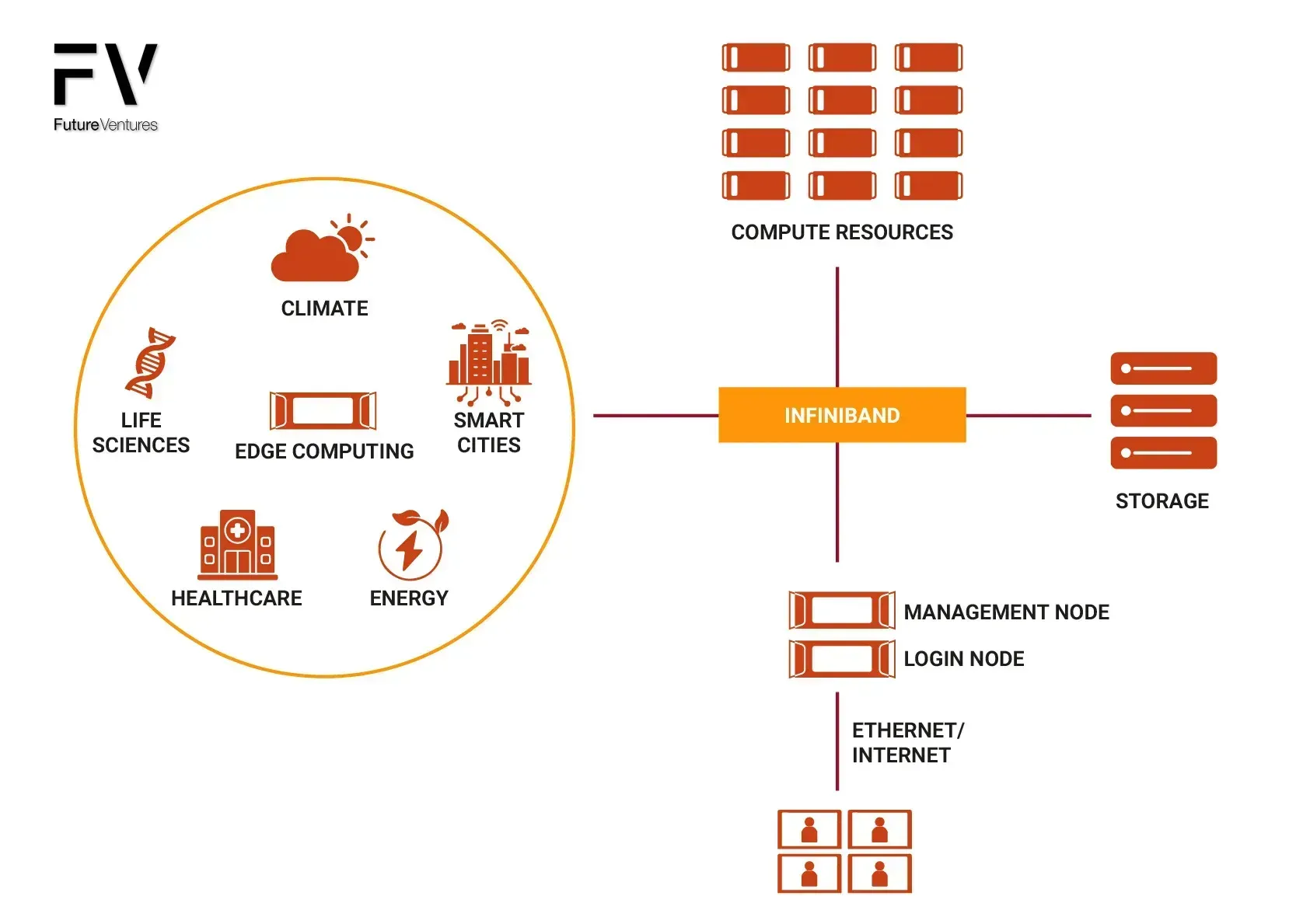
High-performance computing works by combining the computational power of multiple computers to perform large-scale tasks that would be infeasible on a single machine. Here is how HPC works:
By harnessing the collective power of many computers, HPC enables large-scale simulations, data analysis, and other compute-intensive tasks to be completed in a fraction of the time it would take on a single machine.
Modern society is inundated with data, making HPC tools essential for extracting actionable insights quickly. HPC plays a role in everything from scientific research to physics-based simulations, artificial intelligence development, engineering applications, and business use cases. It even allows industries to run simulations that reduce physical testing needs while fuelling game-changing innovations and scientific breakthroughs. Various HPC applications commonly used in scientific and engineering fields include molecular dynamics simulations, computational fluid dynamics, climate modelling, computational chemistry, and machine learning.
HPC allows researchers to perform complex calculations that would otherwise be impractical or impossible with standard computers. It enables them to model physical events and explore vast datasets faster, speeding scientific discovery. HPC may even help answer some of life’s big questions, like why solar flares disrupt radio communications or GPS navigation systems.
Civil engineers use HPC to simulate the performance of bridges and buildings under various environmental conditions, helping optimize designs while avoiding mistakes that would cost time and money to correct physically. Aerospace engineers likewise rely on HPC simulations of prototype aircraft to test them against real-world conditions without needing to fly them to an airport for physical testing.
HPC is also revolutionizing healthcare, speeding drug discovery and speeding time-to-market for new medicines. Furthermore, it can process large volumes of medical data much more efficiently than standard computers would, enabling doctors to diagnose patients faster and make better treatment decisions more rapidly.
Other industries also recognize HPC as an indispensable tool, using it to increase production efficiency and gain a competitive advantage. Manufacturing, for instance, uses HPC extensively to optimize production processes by identifying inefficiencies or conducting tests in virtual environments. It also anticipates demand fluctuations or supply issues before they impact sales.
Supercomputers may reach extreme speeds, but modern HPC solutions use high-performance CPUs and GPUs with all-flash storage and low-latency networking fabrics to achieve breakthrough performance levels at an affordable cost. This makes HPC available to businesses of all sizes. New platforms have also simplified HPC deployment and management by automating setup and resource allocation tools, enabling teams to focus on innovation rather than infrastructure issues.
In summary:
HPC technology provides unparalleled processing power, which is used to solve complex problems in the research, engineering, and business sectors. Furthermore, it plays a crucial role in fighting global issues like pandemics and climate change.
HPC helps organizations gain competitive advantages by rapidly and accurately analyzing data, drawing valuable insights, and making data-driven decisions. Furthermore, HPC enables businesses to reduce physical prototyping and testing costs by creating simulations. This technology is widely utilized across various industries, such as automotive, oil and gas, and aerospace, where simulations of crash tests can replace actual crash testing procedures.
HPC typically runs on a cluster of high-speed computer servers located both on-premises and in the cloud, though supercomputers are the most prominent type. Each supercomputer can process billions of floating point operations (flops) per second.
HPC solutions offer speed, scalability, and flexibility for large enterprises. By leveraging modern processors, GPUs, and low-latency networking fabrics, HPC can run massive computations quickly rather than weeks or months. This helps companies reduce costs by only paying for the resources they use while scaling them as necessary.
Healthcare professionals rely on HPC for DNA sequencing and data analysis. This enables them to quickly identify genetic markers linked to diseases and speed up screening techniques for life-saving treatments. HPC can also speed up drug discovery by simulating molecular interactions, significantly shortening the time it takes to market.
HPC has also helped accelerate the advancement of artificial intelligence (AI) by providing the computational power necessary to train complex deep learning models. Together, AI and HPC are revolutionizing numerous industries - natural language processing, image recognition, autonomous vehicles and more are being transformed by this combination. With more organizations striving to accelerate innovation while making more informed decisions - especially those operating within sectors where errors may have drastic repercussions, such as defence or finance - demand for HPC is expected to continue rising as more organizations look for ways to expedite innovation by training complex deep learning models using HPC as part of an innovation acceleration strategy.
In summary:
HPC can be more costly than traditional computing because it requires additional hardware and software to meet high-demand workloads. It also requires a specialized IT team to design, install, and manage it, which can significantly increase costs. Furthermore, it consumes vast quantities of electricity while increasing operational expenses related to electricity use and cooling.
However, HPC can quickly recover its initial investment by shortening the time to solution and increasing productivity. Furthermore, physical testing could become obsolete in sectors like defence and finance, where errors have catastrophic repercussions, leading to lower test costs per test.
HPC computers employ parallel processing across a network of processors to carry out calculations concurrently and significantly speed them up. This drastically cuts processing times for tasks like climate modelling, financial simulations, and AI training, which require both speed and accuracy.
HPC technology allows us to solve problems more rapidly than traditional computing can, often in minutes. Modern CPUs and GPUs, along with low-latency networking fabrics and all-flash storage devices, allow complex calculations to be completed quickly compared with weeks or months in traditional computing environments.
HPC can accelerate scientific, technological, and business innovation to help us shape a bright future for all. Today's ecosystem is filled with data, which HPC in the cloud quickly processes for insights that bring forth new innovations. HPC helps companies predict market fluctuations and forecast business scenarios while helping scientists model potential outbreaks and decode cancerous cell genomes.
When calculating the true internal cost of HPC, it's essential to take a close look at both utilization rates and peak usage, then compare those costs against on-demand pricing for Rescale's HPC+ core type (the most widely adopted HPC solution). If your team supports peak usage at 100% utilization, for instance, this comes out to $0.38/core-hour in comparison with $0.15/core-hour on-demand pricing - representing an incredible value proposition!
IT teams looking to lower costs should opt for a cloud provider that constantly updates its infrastructure to optimize performance. This includes upgrades to computer processors, storage solutions, and management tools that give a granular view of costs. In addition, energy costs should also be considered; on-premise HPC solutions can cost millions annually in electricity use, whereas cloud providers that prioritize renewable energy solutions can significantly reduce these expenses.
The field of high-performance computing (HPC) is constantly evolving, driven by emerging technologies and innovative approaches. Several trends are shaping its future, promising to unlock new possibilities and applications.
The future of HPC is anticipated to involve integrating artificial intelligence, machine learning, and other emerging technologies to enhance performance and efficiency. HPC will remain a vital component in scientific research, computational science, and engineering applications. As HPC continues to advance, it will be crucial to tackle challenges such as security, scalability, and energy efficiency.
High-performance computing is a powerful tool that enables researchers and scientists to perform complex calculations at high speeds. HPC has a wide range of applications across multiple industries, including scientific research, computational science, and engineering. As HPC continues to evolve, it will be important to stay up-to-date with the latest developments and advancements in the field.
Here are some ways you can get started in high-performance computing, including reading NVIDIA's free HPC e-book and HPC blogs.
If you want to deepen your understanding of HPC, consider enrolling in online courses or pursuing a degree in computer science, engineering, or a related field for a more comprehensive grasp of the subject
Learn how seed strapping can fuel your startup's growth. Discover practical strategies and insights to navigate this crucial funding stage. Read more!
Learn how the Lehman scale sets M&A and capital-raising success fees: the Lehman formula, Double Lehman, modern variations and what founders should negotiate.
Explore the J Curve's implications for investors and strategists, balancing risks and rewards. Gain insights to enhance your decision-making—read more now!
Learn practical strategies to overcome common challenges as a first-time fund manager. Dive into our guide for essential tips and insights. Read more!
MIT found 95% of AI pilots fail. See how companies use AI to improve client workflows — and why integration decides the winners.
Discover how the CEO of the future is transforming business leadership and driving change. Read the article to learn more about this emerging role.
Quality of Earnings (QoE): understand what buyers and investors look for, uncover red flags, and boost valuation before your exit.
Maximize your productivity with our CEO time management template. Learn strategies to structure your day effectively. Read more for practical insights!
How founders use a 90-day execution sprint to turn strategy into results: set quarterly priorities, align the team and keep everyone accountable for progress.
Discover key insights on investor perceptions when founders become defensive. Learn tips to navigate tough conversations effectively. Read the article now!








