
Seed-Strapping: The Founder's Playbook for Scaling Without Surrendering Control
Learn how seed strapping can fuel your startup's growth. Discover practical strategies and insights to navigate this crucial funding stage. Read more!



The implementation of 25% US tariffs on $155 billion of Canadian exports has created an unprecedented risk environment for cross-border commerce. The tariffs are part of a broader plan to impose tariffs on imported goods from Canada, Mexico, and China. The new implementation date for the tariffs is set for April 2.
For Canadian enterprises, this represents both a systemic shock to integrated North American supply chains and a catalyst for fundamental reconfiguration of trade dependencies. This analysis reorients global tariff risk management strategies through a distinctly Canadian lens, focusing on sectoral vulnerabilities, domestic policy tools, and opportunities for hemispheric trade realignment.
Heads of Enterprise Risk Management (ERM) can support their organizations in addressing potential tariff impacts by evaluating risk exposure, testing the effectiveness of risk owners’ mitigation strategies, and performing scenario analyses to forecast possible outcomes. The imposition of tariffs is expected to have significant repercussions for Canadian businesses and the broader Canadian economy. Organizations need to assess how President Donald Trump’s sweeping U.S. tariff declarations and retaliatory actions from other nations might influence their ability to provide essential goods and services. ERM leaders are ideally situated to help their organization quantify the risk and respond adequately through these three steps:
The imposition of tariffs is expected to have significant repercussions for Canadian businesses and the broader economy. Higher operational costs can squeeze profit margins, reduce cash flow, and limit the ability to reinvest in growth, particularly affecting Canadian goods. The tariffs can also lead to a decline in exports, weaken Canada’s GDP, slow economic growth, and increase unemployment.
Canadian companies should assess their exposure to the tariffs and develop strategies to mitigate the risks.
Prepare your organization for the effects, range, and length of U.S. tariff policies by using the table below to pinpoint relevant risks to your business. This table highlights key risk indicators (KRIs) along with their implications from tariff actions. While we’ve approached this from a broader Canadian business perspective, feel free to use it as a foundational tool in assessing the risks and potential opportunities that U.S. tariffs may offer your company.
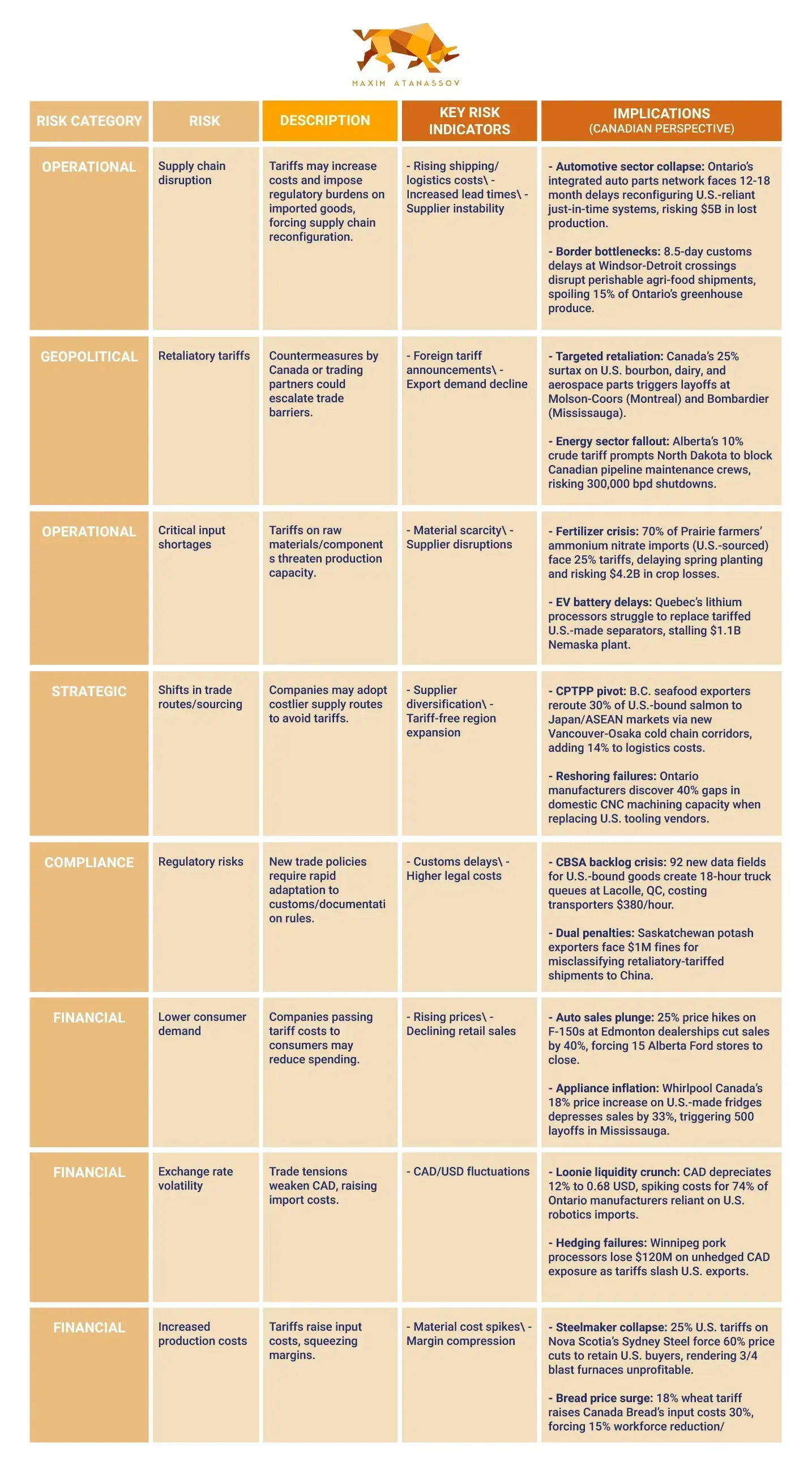
Preparing risk owners to navigate tariff volatility and uncertainty is a critical step for Canadian businesses facing the challenges posed by the 2025 US tariffs. This preparation involves a multi-faceted approach that empowers risk owners to take informed actions and make strategic decisions.
Firstly, it is essential to foster a culture of collaboration and open communication across the organization. Risk owners should be encouraged to share insights and experiences, creating a collective understanding of the potential impacts of tariffs on different business areas. Regular meetings and workshops, via a Risk or Tariffs Taskforce, can facilitate this exchange of information, helping to identify vulnerabilities and opportunities within the organization.
Secondly, equip risk owners with the necessary tools and resources to analyze and respond effectively to tariff-related risks. This includes access to real-time data on tariff changes, market trends, and geopolitical developments. By leveraging advanced analytics and scenario modelling, risk owners can better predict potential outcomes and develop contingency plans to mitigate adverse effects.
Furthermore, it is crucial to establish a clear framework for decision-making that aligns with the organization's overall strategic objectives. Risk owners should be empowered to make timely decisions based on predefined criteria and thresholds, ensuring a swift response to emerging threats or opportunities. This may involve setting up a dedicated task force or committee to oversee tariff-related decisions and actions.
Training and development programs are also vital in enhancing the capabilities of risk owners. Providing targeted training on topics such as international trade laws, customs regulations, and supply chain management can equip risk owners with the knowledge needed to navigate complex tariff landscapes. Additionally, fostering partnerships with external experts and industry associations can provide valuable insights and support in managing tariff-related challenges.
Finally, encourage risk owners to adopt a proactive mindset by continuously monitoring the external environment and identifying early warning signals of potential tariff changes. This proactive approach allows businesses to anticipate disruptions and adjust strategies accordingly, minimizing the impact on operations and financial performance.
By implementing these strategies, Canadian businesses can empower their risk owners to effectively navigate tariff volatility and uncertainty, ensuring resilience and agility in an ever-changing trade landscape.
Use scenario analysis to drive immediate action so your organization is prepared to respond to tariff impacts when they materialize. Invite risk owners involved in managing tariff risk to partake in a session to identify value at risk, interim signals and low-cost actions to take now.
Frame your conversation around core value drivers that may be at risk if tariffs impact your organization. For example, a tariff may hinder your organization’s ability to deliver a core product or service, potentially resulting in lost customer trust.
After determining the core value at risk, work with the group to determine interim events that could indicate the risk is materializing. This will help you determine the actions (and associated timelines) to take in preparation.
For example, if the interim event increased the cost of critical supplies, you might ask participants, “What are the first three things we could do if the cost of critical supplies increased?”
Use the responses from this conversation to identify two or three low-cost, low-regret actions your participants can take now to prepare your organization.
In conclusion, the strategic response framework for Canadian enterprises in light of the 2025 US tariffs underscores the importance of proactive risk management and strategic planning. Canadian businesses face significant challenges due to the tariffs imposed on cross-border trade, which could disrupt supply chains, increase costs, and impact market access. However, by employing a robust enterprise risk management approach, businesses can effectively navigate these challenges.
Key takeaways include:
By focusing on these strategic areas, Canadian enterprises can not only withstand the immediate impacts of US tariffs but also position themselves for long-term success in an evolving global trade environment.
Need assistance with the assessment and mitigation of tariff risks? Ready to help!
Maxim Atanassov is a Calgary-based business transformation specialist with over two decades of strategic leadership experience across multiple industries. Maxim leverages his financial acumen and technological expertise to drive organizational change and innovation. A serial entrepreneur, tech founder, and investor, he excels at transforming operations and building new capabilities that consistently achieve top-decile performance. Maxim's approach combines AI implementation with strategic governance, helping businesses navigate technological disruption while managing risk. Clients praise his ability to drive clarity in ideation processes and implement solutions, generating exponential growth.
Learn how seed strapping can fuel your startup's growth. Discover practical strategies and insights to navigate this crucial funding stage. Read more!
Learn how the Lehman scale sets M&A and capital-raising success fees: the Lehman formula, Double Lehman, modern variations and what founders should negotiate.
Explore the J Curve's implications for investors and strategists, balancing risks and rewards. Gain insights to enhance your decision-making—read more now!
Learn practical strategies to overcome common challenges as a first-time fund manager. Dive into our guide for essential tips and insights. Read more!
MIT found 95% of AI pilots fail. See how companies use AI to improve client workflows — and why integration decides the winners.
Discover how the CEO of the future is transforming business leadership and driving change. Read the article to learn more about this emerging role.
Quality of Earnings (QoE): understand what buyers and investors look for, uncover red flags, and boost valuation before your exit.
Maximize your productivity with our CEO time management template. Learn strategies to structure your day effectively. Read more for practical insights!
How founders use a 90-day execution sprint to turn strategy into results: set quarterly priorities, align the team and keep everyone accountable for progress.
Discover key insights on investor perceptions when founders become defensive. Learn tips to navigate tough conversations effectively. Read the article now!








