

Seed-Strapping: The Founder's Playbook for Scaling Without Surrendering Control
Learn how seed strapping can fuel your startup's growth. Discover practical strategies and insights to navigate this crucial funding stage. Read more!


"Don’t play the game, own the board."
In a world where startups launch faster than you can say "Series A," a new model is quietly flipping the table: the Venture Studio. This isn't just about chasing unicorns; it's about breeding them—systematically, repeatedly, and efficiently. Let’s dive deep into what makes this model the future of entrepreneurship.
A Venture Studio is a company that creates startups from scratch. Not accelerates them. Not funds them. But builds them!
Think of it as a startup factory, with an assembly line of ideas, talent, and capital. Venture studios generate ideas, test them, assemble teams, and provide the first capital to bring the business to life. They often source business ideas from their own network and assign in-house teams to develop these ideas into startups. Startups developed within a venture studio have immediate access to experienced entrepreneurs and mentors, which significantly enhances their chances of success.
Unlike a startup studio, which focuses on ideating, building, and launching new startups with significant operational involvement and a co-founding role, venture studios are methodical, research-driven, and tech-savvy. They are often funded by external investors and increasingly popping up far from traditional tech hubs like San Francisco—in places like Austin, Berlin, and even Calgary.
Refer to our In-depth Guides on the differences between:
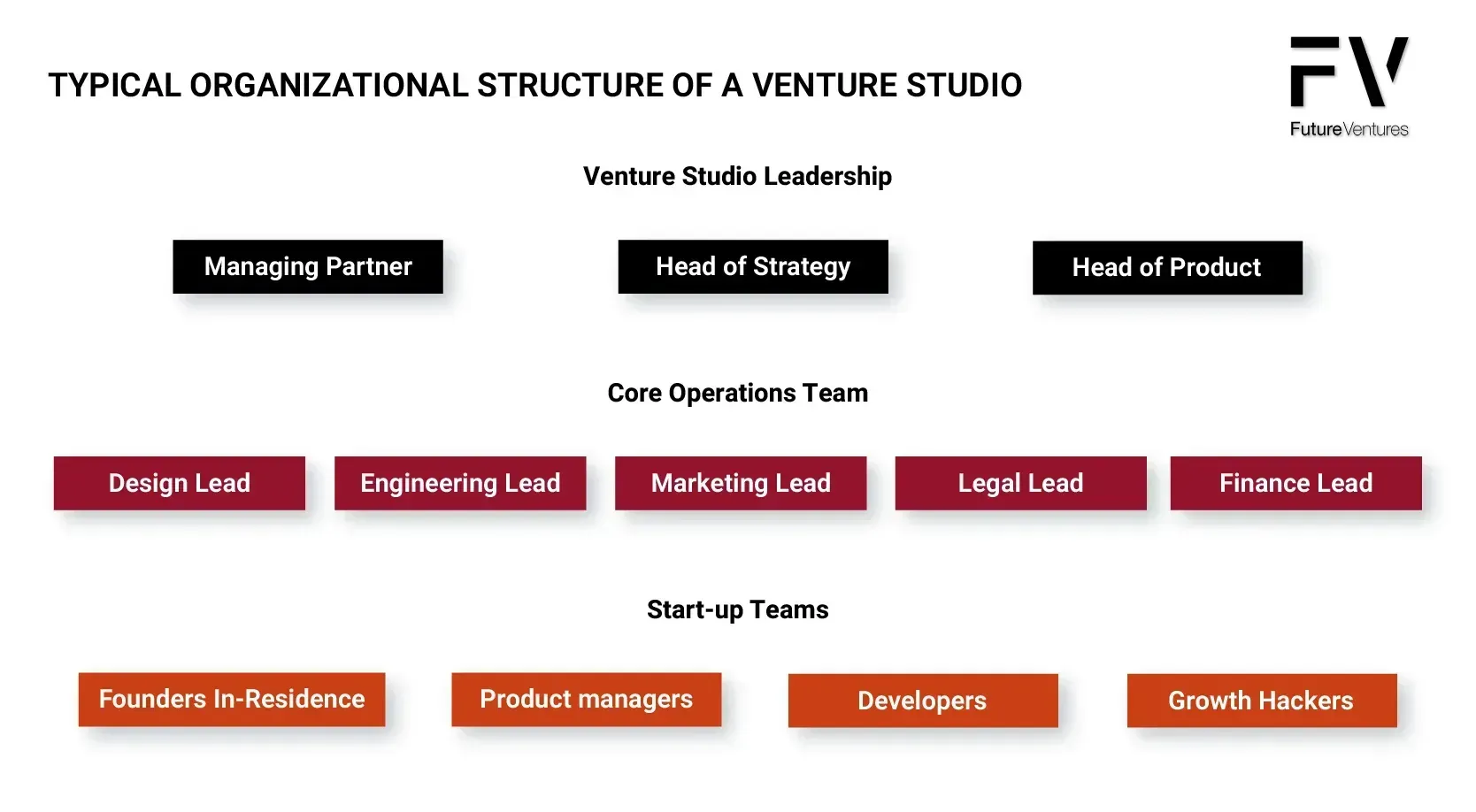
The leadership team in a venture studio is crucial for fostering innovation and risk-taking. They encourage the in-house team to experiment and learn from both successes and failures, creating a dynamic environment for new business ideas to thrive. This culture of innovation ensures that startups can evolve into successful ventures.
Additionally, the leadership team is instrumental in forming strategic partnerships. By leveraging their extensive networks, they secure collaborations that provide startups with essential resources, expertise, and insights. These partnerships are vital for supporting startups through various stages.
Beyond the core leadership team, venture studios typically feature an extended team of professionals who bring specialized skills to the table. This includes:
Core teams are made of serial entrepreneurs, data scientists, product nerds, and investors. These individuals bring a wealth of experience and deep industry knowledge, allowing the venture studio to navigate the complexities of startup creation efficiently. Their expertise in various domains ensures that each startup has a solid foundation and strategic guidance from the outset.
Mentors and advisors play a vital role, shaping early strategy and avoiding obvious pitfalls. Their involvement is crucial in the early stages as they provide insights and feedback that help refine business models and product offerings. This mentorship is not only about avoiding mistakes but also about identifying market opportunities and crafting innovative solutions that align with current trends.
In a venture studio, startup teams consist of a carefully selected group of professionals who are believed to have the right mix of chemistry, determination, and expertise to turn an idea into a successful venture. These teams usually include experienced entrepreneurs, product managers, developers, marketing specialists, and financial analysts.
Venture studios cultivate a collaborative atmosphere where diverse teams unite to achieve shared objectives. Through regular meetings, workshops, and brainstorming sessions, they foster open communication and innovation, enabling teams to swiftly adapt to shifting market dynamics and new opportunities. This collaborative spirit ensures the efficient transformation of business ideas into successful ventures. By harnessing the collective expertise of the team, venture studios equip each startup to effectively tackle the challenges of early development stages and achieve rapid growth.
In addition to their internal teams, venture studios often form strategic partnerships with external entities, including industry experts, academic institutions, and corporate partners. These partnerships provide access to additional resources, expertise, and market insights, enhancing the studio's ability to create successful startups.
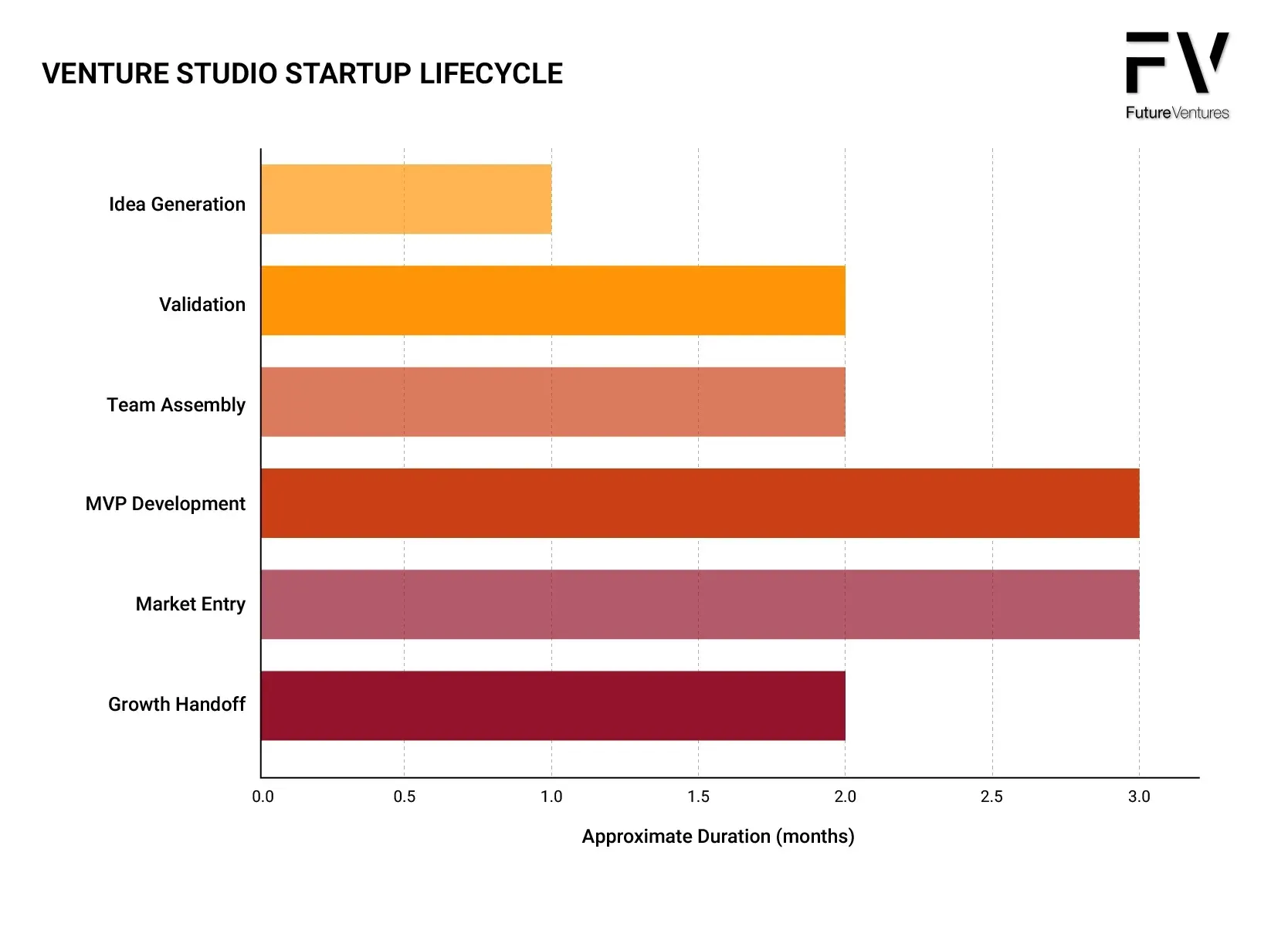
Identifying market opportunities is a cornerstone of the venture studio model. Venture studios employ a variety of methods to uncover potential market gaps, including rigorous market research, in-depth customer interviews, and expert analysis. They also tap into their extensive network of partners, investors, and industry experts to gain insights into emerging trends and technologies. By pinpointing market opportunities early, venture studios can craft business ideas that resonate with market needs and have a higher likelihood of success.
Key factors considered when identifying market opportunities include:
By meticulously evaluating these factors, venture studios can align their business ideas with their expertise and resources, setting the stage for successful startup creation.
Developing a Competitive Business Model
Crafting a competitive business model is pivotal in the venture studio model. Venture studios utilize various tools and frameworks to design business models that are not only innovative but also tailored to the specific market and business idea. Leveraging their deep expertise and resources, they develop models that are scalable, sustainable, and profitable.
Key considerations in developing a competitive business model include:
By carefully considering these factors, venture studios can develop business models that are not only competitive but also poised for long-term success.
Creating a new business is the ultimate goal of the venture studio model. Venture studios leverage their extensive expertise and resources to transform business ideas into thriving startups. They provide crucial funding, mentorship, and support, guiding entrepreneurs through the complex journey of building a new business.
Key steps involved in creating a new business include:
By providing comprehensive support and resources, venture studios help entrepreneurs navigate the challenges of building a new business, significantly increasing their chances of success.
Minimum Viable Product (MVP) development is a critical phase in the venture studio model, as it allows startups to test their core ideas with minimal resources. This phase focuses on creating a simplified version of the product that includes only the essential features necessary to validate the business concept and gather user feedback.
By embracing MVP development, venture studios can efficiently validate business ideas, refine their offerings, and set the stage for successful market entry and growth.
The growth handoff is a pivotal moment in the venture studio model, marking the transition from startup development to scaling and expansion. This phase involves transferring the startup from the nurturing environment of the venture studio to external investors or strategic partners who specialize in scaling businesses. The goal is to ensure that the startup has a solid foundation, a validated business model, and a minimum viable product (MVP) ready for rapid growth.
The growth handoff is a critical step in the venture studio business model, enabling startups to transition from the nurturing environment of the studio to the broader market, where they can achieve their full potential. By carefully managing this transition, venture studios set their startups up for success in the competitive startup ecosystem.
The venture studio model offers numerous benefits and advantages to entrepreneurs and startups. Some of the key benefits include:
By offering these benefits, venture studios empower entrepreneurs and startups to build successful businesses and achieve their goals.
While the venture studio model presents numerous advantages, it also comes with its own set of challenges and considerations. Some of the key challenges include:
By carefully evaluating these challenges and developing strategies to address them, venture studios can enhance their chances of success and continue to innovate in the startup ecosystem.
| Feature | Venture Stud | Incubator | Accelerator | VC Fund |
|---|---|---|---|---|
| Idea Source | Internal | External (founder | External (founders) | External (founders) |
| Team Assembly | In-house | Founder-led | Founder-led | N/A |
| Capital Provided | Early-stage (pre-seed) | Often none | Seed-stage | All stages |
| Support Duration | Long-term | Short-term | Fixed-term | Ad hoc |
| Revenue Model | Equity | Rent or small equity | Equity | Equity |
| Focus | Systematic startup creation | Founder support | Founder support | Funding only (traditional venture capital funds) |
If venture capital is betting on horses, venture studios are building the stables. In a world where speed, precision, and iteration matter more than luck and charisma, studios offer a modernized, technology-first path to startup success.
In the next decade, the most valuable startups may not be born in garages—but on assembly lines.
Learn how seed strapping can fuel your startup's growth. Discover practical strategies and insights to navigate this crucial funding stage. Read more!
Learn how the Lehman scale sets M&A and capital-raising success fees: the Lehman formula, Double Lehman, modern variations and what founders should negotiate.
Explore the J Curve's implications for investors and strategists, balancing risks and rewards. Gain insights to enhance your decision-making—read more now!
Learn practical strategies to overcome common challenges as a first-time fund manager. Dive into our guide for essential tips and insights. Read more!
MIT found 95% of AI pilots fail. See how companies use AI to improve client workflows — and why integration decides the winners.
Discover how the CEO of the future is transforming business leadership and driving change. Read the article to learn more about this emerging role.
Quality of Earnings (QoE): understand what buyers and investors look for, uncover red flags, and boost valuation before your exit.
Maximize your productivity with our CEO time management template. Learn strategies to structure your day effectively. Read more for practical insights!
How founders use a 90-day execution sprint to turn strategy into results: set quarterly priorities, align the team and keep everyone accountable for progress.
Discover key insights on investor perceptions when founders become defensive. Learn tips to navigate tough conversations effectively. Read the article now!