

Seed-Strapping: The Founder's Playbook for Scaling Without Surrendering Control
Learn how seed strapping can fuel your startup's growth. Discover practical strategies and insights to navigate this crucial funding stage. Read more!


The startup ecosystem resembles a complex evolutionary system where only the fittest survive. Traditional startups face a staggering mortality rate. 90% die before gaining significant traction.
But what if you could dramatically improve those odds?
Enter the world of venture studios and incubators, where the traditional “figure-it-out-yourself” approach is replaced with structured systems designed to increase your chances of survival. These systems often include incubator or accelerator programs, which support startups at different stages. Incubators focus on developing early-stage ideas into viable products, while accelerators help scale these startups after initial success.
Today’s guide dissects these models with surgical precision to help you choose your optimal path forward.
Incubators are the kindergartens of the startup world—nurturing environments where founders learn the basics before entering the cutthroat business playground. They don't build the companies; they create conditions for entrepreneurs to build their own.
Imagine walking into a collaborative workspace filled with other wide-eyed founders, all sharing the communal coffee machine and trading war stories. That's incubator life. These programs provide the foundational infrastructure—office space, internet access, basic legal templates—while you figure out if your brilliant idea actually solves a real problem.
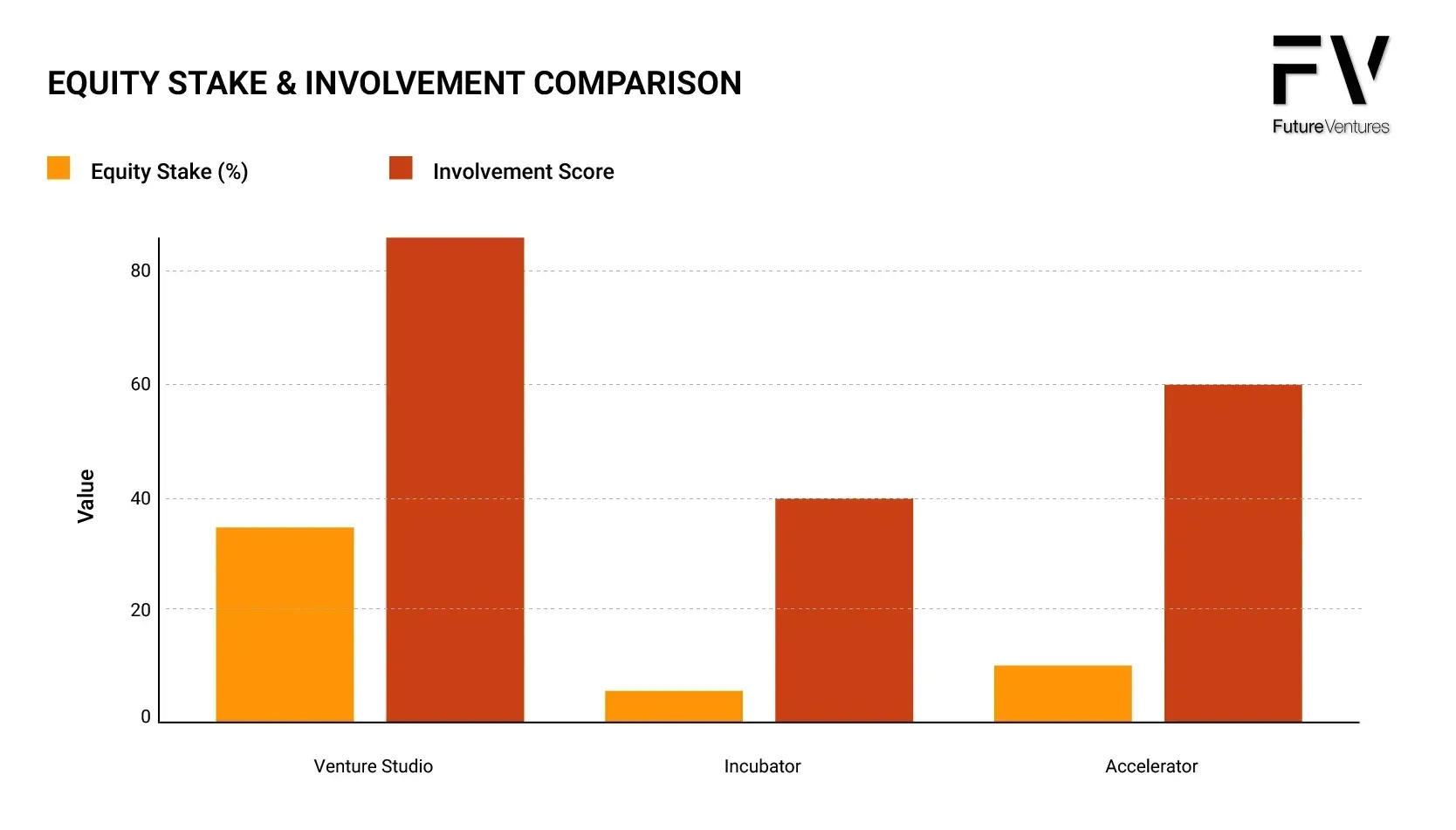
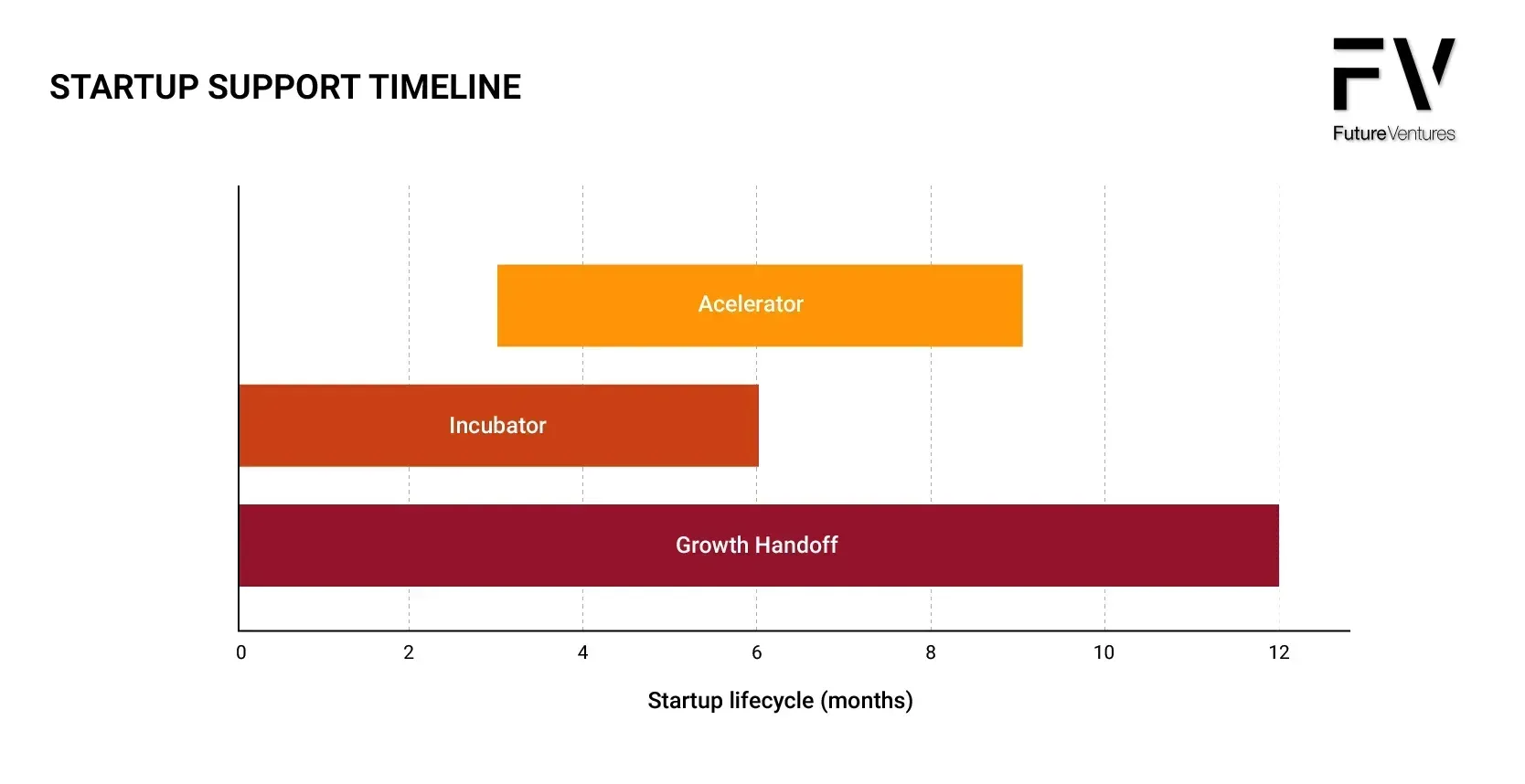
Incubators typically engage with startups during the first 6 months of their lifecycle, providing a moderate level of hands-on support (scoring about 40/100 on the involvement scale) while taking minimal equity (around 7%). They excel at helping you navigate regulatory requirements, connect with mentors and build your initial network.
Venture studios are the SEAL teams of company building—elite, experienced, and equipped with specialized tools to construct businesses with military precision. Unlike incubators, studios don’t just provide space and occasional guidance; they actively co-found and co-build your company.
Most venture studios can accelerate the timeline from concept to market launch significantly, often achieving this within 6-12 months.
A venture studio is essentially a co-founder with supernatural powers—they’ve done this dozens of times before and maintain dedicated teams for every function your startup needs: product, engineering, marketing, sales, finance, and HR. They’re not mentors giving occasional advice; they’re in the trenches with you, day in and day out.
The data indicates that venture studios exhibit the highest level of involvement (90/100) and generally acquire a significant equity stake (usually 35%). Their support spans the entire startup lifecycle—typically lasting 12 months or longer—and their model is crafted to systematically mitigate risks at every stage of development.
The fundamental distinction lies in their operational approach:
| Feature | Venture Studio | Incubator | Accelerator |
|---|---|---|---|
| Equity Stake | 35% (20-80% range) | 7% (5-10% range) | 10% (5-15% range) |
| Involvement Level | 90/100 | 40/100 | 60/100 |
| Support Duration | 12 months | 6 months | 3-6 months |
| Idea Source | Often generated internally | External entrepreneurs | External startups |
| Primary Value | End-to-end company building | Nurturing environment | Rapid scaling |
| Funding Provided | $500K-$2M+ | Limited or none; often rely on venture capital firms to supply the necessary capital for startups in exchange for equity | $50K-$150K |
| Time to Seed | 10.7 months | 36 months (traditional) | Varies |
Venture studios roll up their sleeves and get their hands dirty in day-to-day operations. They don’t just advise—they execute. When your marketing strategy needs work, they don’t recommend a course; they bring in their CMO to redesign it. Incubators point you to resources; studios become your resources.
If incubators are kindergartens and venture studios are elite military units, accelerators are high-intensity fitness boot camps—they take reasonably fit companies and put them through an intense training regimen to prepare them for the Olympics of business growth. An accelerator program is a structured, time-limited initiative that helps startups transition from early stages to significant growth. These programs provide rigorous involvement and support, focusing on mentorship, networking, and preparing participants for investor engagement.
Accelerators are looking for startups that have moved beyond ideation. You need a functioning product, early evidence of traction, and a cohesive team. Their programs typically run 3-6 months with clear milestones and culminate in a “demo day” where you pitch to investors.
With a moderate-to-high involvement score of 60/100 and equity stakes averaging 10%, accelerators occupy the middle ground between incubators and studios. They focus primarily on months 3-8 of a startup’s lifecycle, targeting rapid growth rather than foundational development.
Venture Studio Tradeoffs:
The decision between incubation and studio models requires brutal honesty about your capabilities, resources, and goals. Consider:
Startup Support Timeline
The company-building ecosystem has experienced explosive growth. Ten years ago, approximately 130 venture studios operated globally; today, that number exceeds 720. This growth reflects increasing specialization—studios now focus on specific verticals like B2B SaaS, healthcare, fintech, or consumer products.
This specialization creates interesting opportunities for founders. Rather than generic support, you can now partner with studios possessing deep domain expertise in your specific market. The best studios combine startup methodologies with industry-specific knowledge, creating a formidable advantage.
Meanwhile, corporate incubators have emerged as established companies seek to foster innovation without disrupting core operations. These programs leverage corporate resources, distribution channels, and customer relationships while maintaining the agility of startup structures.
The venture studio model is gaining traction for one simple reason: it works. Traditional startups face daunting odds—a Harvard Business School study reveals that 75% of venture-backed startups never return capital to investors, with overall failure rates approaching 90%. Against this backdrop, venture studios' systematic approach to company building delivers compelling advantages.
Studios have collectively raised over $21 billion, though funding remains concentrated—the top 20 studios control approximately 80% of total funding. This concentration is beginning to disperse as the model gains validation through successful exits and superior performance metrics.
The most significant competitive advantage for venture studios is time compression. Studio startups reach seed funding in 10.7 months compared to approximately 36 months for traditional ventures—an acceleration that creates substantial value in time-sensitive markets.
The venture studio model is revolutionizing the traditional venture landscape by offering a new paradigm for launching startups. Unlike the conventional approach, where founders often struggle to secure resources, funding, and expertise, venture studios provide a comprehensive platform that addresses these needs head-on. This model is particularly advantageous for early-stage startups, which typically face significant hurdles in their initial phases.
Venture studios are essentially startup factories, equipped with experienced entrepreneurs, investors, and industry experts who work collaboratively to build and scale new ventures. These studios don’t just offer advice; they actively participate in the creation and growth of the startups, providing hands-on support across various business functions. This involvement significantly reduces the risk of failure, which is a common fate for many early-stage startups.
The venture studio model is designed to systematically eliminate common failure points by offering a structured environment where startups can thrive.
For instance, many venture studios have dedicated teams for product development, marketing, sales, and finance, ensuring that experts handle each aspect of the business. This holistic approach not only accelerates the time-to-market but also enhances the overall quality and viability of the startups.
Moreover, venture studios typically provide initial capital and have strong connections with follow-on investors, ensuring that startups have the financial backing they need to grow. This funding certainty, combined with the comprehensive support system, makes venture studios an attractive option for early-stage startups looking to maximize their chances of success.
Venture studios have produced notable successes across diverse industries:
These examples demonstrate how specialized knowledge, systematic processes, and shared resources can dramatically improve outcomes compared to the traditional founder-centric approach.
Major corporations increasingly leverage the venture studio model to explore adjacent markets without disrupting core operations:
Corporate studios combine the resources and distribution advantages of established companies with the speed and agility of startup structures. This hybrid approach enables the exploration of disruptive opportunities while managing risk and maintaining alignment with strategic objectives.
Corporate startup incubators represent a unique fusion of the agility of startups with the resources and stability of large corporations. These incubators are essentially a type of venture studio sponsored by established companies, designed to foster innovation and explore new business models. By providing resources, funding, and expertise, corporate startup incubators offer a nurturing environment for startups to grow and succeed.
For large corporations, these incubators serve as a strategic tool to stay ahead of the competition. By investing in new technologies and innovative business models, corporations can explore adjacent markets and diversify their portfolios without disrupting their core operations. This approach allows them to remain competitive in a rapidly changing business landscape.
Startups, on the other hand, benefit immensely from the support of a corporate incubator. They gain access to the corporation’s vast resources, including funding, office space, and industry expertise. Additionally, the association with a well-established brand can provide credibility and open doors to new opportunities. In exchange, the corporation typically takes an equity stake in the startup, aligning interests and ensuring mutual benefit.
Examples of successful corporate startup incubators include Jaguar Land Rover’s InMotion Ventures, which focuses on developing mobility solutions, and Procter & Gamble’s P&G Ventures, which explores new consumer categories. These incubators leverage the strengths of their parent companies while maintaining the flexibility and innovation-driven culture of a startup, creating a win-win scenario for both parties.
By combining the best of both worlds, corporate startup incubators offer a powerful platform for launching and scaling new ventures, driving innovation, and creating value for all stakeholders involved.
Let's be brutally honest: most entrepreneurs overestimate their capabilities, underestimate the challenges of building successful companies and the time that it will take to achieve milestones. The romantic notion of the solo founder creating billion-dollar enterprises through sheer brilliance is largely mythological—most successful startups benefit from systems, structures, and support networks that compensate for inevitable founder limitations.
The optimal support model depends on your specific circumstances:
The common thread across successful startups isn't solo heroics—it's the intelligent application of established methodologies, access to relevant expertise, and strategic deployment of resources against well-defined objectives. Whether you choose an incubator's collaborative community or a venture studio's comprehensive support system, the key is an honest assessment of your needs and limitations.
The most successful founders aren't those who do everything themselves—they're the ones who leverage every available resource to maximize their probability of success.
Learn how seed strapping can fuel your startup's growth. Discover practical strategies and insights to navigate this crucial funding stage. Read more!
Learn how the Lehman scale sets M&A and capital-raising success fees: the Lehman formula, Double Lehman, modern variations and what founders should negotiate.
Explore the J Curve's implications for investors and strategists, balancing risks and rewards. Gain insights to enhance your decision-making—read more now!
Learn practical strategies to overcome common challenges as a first-time fund manager. Dive into our guide for essential tips and insights. Read more!
MIT found 95% of AI pilots fail. See how companies use AI to improve client workflows — and why integration decides the winners.
Discover how the CEO of the future is transforming business leadership and driving change. Read the article to learn more about this emerging role.
Quality of Earnings (QoE): understand what buyers and investors look for, uncover red flags, and boost valuation before your exit.
Maximize your productivity with our CEO time management template. Learn strategies to structure your day effectively. Read more for practical insights!
How founders use a 90-day execution sprint to turn strategy into results: set quarterly priorities, align the team and keep everyone accountable for progress.
Discover key insights on investor perceptions when founders become defensive. Learn tips to navigate tough conversations effectively. Read the article now!








