Seed-Strapping: The Founder's Playbook for Scaling Without Surrendering Control
Learn how seed strapping can fuel your startup's growth. Discover practical strategies and insights to navigate this crucial funding stage. Read more!


The differences between both venture studios and accelerators represent more than just a semantic distinction—they embody fundamentally different philosophical approaches to startup creation and growth. With venture studios showing 30% higher success rates than traditional startups and offering comprehensive resources beyond just financial resources and accelerators providing proven scaling frameworks, choosing the right path could be the most consequential decision you make for your entrepreneurial journey. This comprehensive guide dissects both models, offering an incisive analysis of which option aligns best with your vision, resources, and growth trajectory.
The startup ecosystem has evolved beyond the traditional bootstrap-or-VC-funding binary. Today’s entrepreneurs face a more nuanced landscape where specialized support structures can dramatically alter a startup’s trajectory. Let’s dissect these options to understand their fundamental philosophies.
Different support systems, such as incubators, accelerators, and venture studios, play a crucial role in shaping the startup journey by providing comprehensive guidance tailored to various stages, enhancing innovation, collaboration, and long-term success.
Startup accelerators function as high-intensity boot camps for existing startups with some market validation. Think of them as the CrossFit of startup development: focused, intense, and designed to produce rapid results in a condensed timeframe. Accelerators help early-stage startups scale and quickly get their product to market.
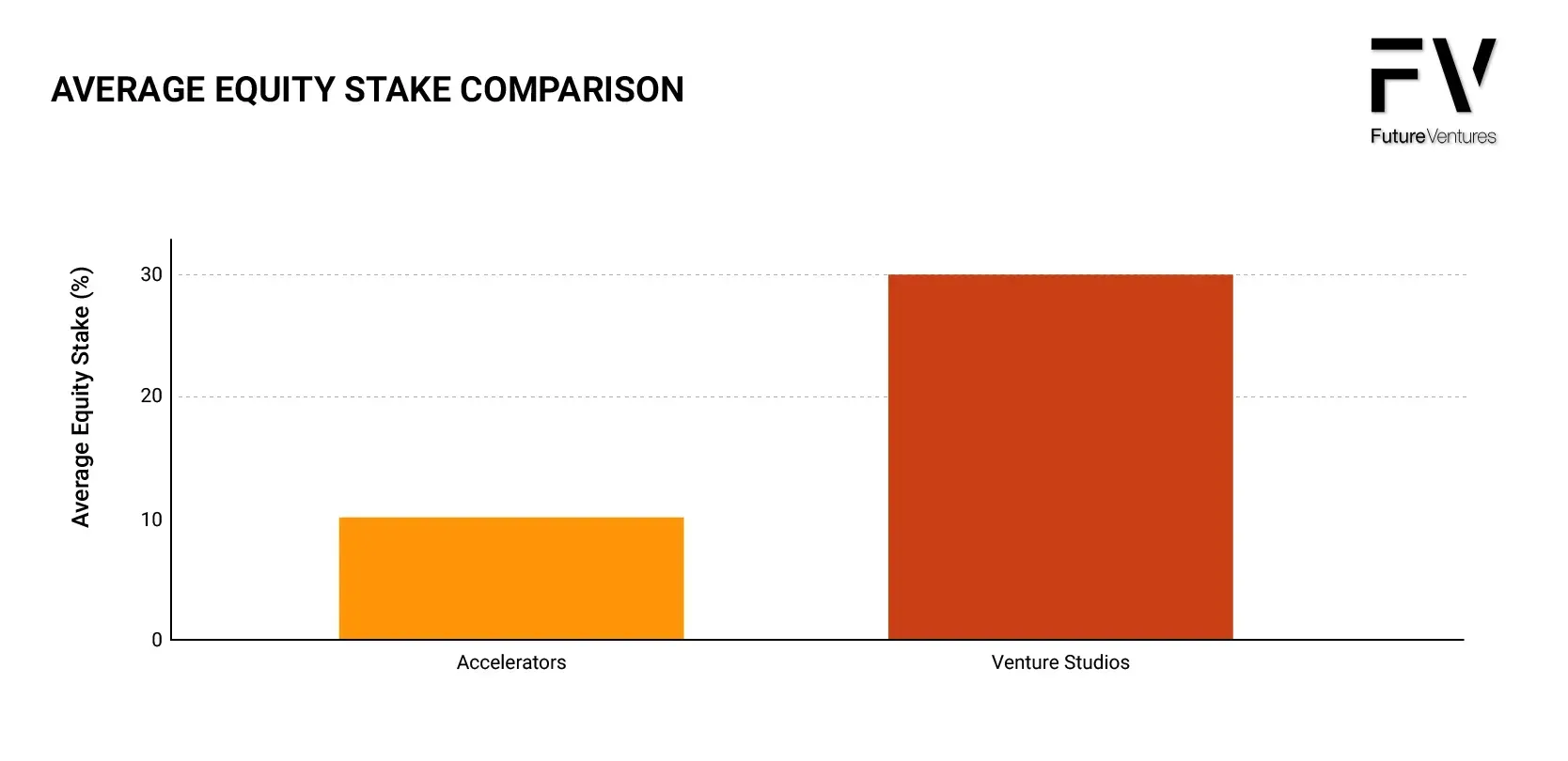
Accelerators operate on a fixed timeline (typically 3-6 months) with structured programming aimed at rapidly scaling businesses that already have a minimum viable product (MVP). They seek startups with a solid business model ready for rapid growth, providing seed funding (usually in exchange for 5-15% equity), mentorship from industry veterans, and networking opportunities that culminate in a “demo day” pitch event to potential investors.
Additionally, accelerators typically offer mentorship, networking, and initial funding, often in exchange for smaller equity stakes, compared to venture studios.
Y Combinator, Techstars, and 500 Startups have perfected this model, focusing on speed and scale rather than ideation and fundamental business building. The accelerator approach works well for founders who already have a solid concept and MVP but need resources, connections, and strategic guidance to scale quickly.
Despite not having an active accelerator program in Canada at the moment, Techstars is the largest eary stage investor in Canada, with a portfolio of 265 companies.
If you reside in Alberta, please consult our comprehensive guide on Accelerator programs. All of the accelerators in Alberta are non-equity as government programs fund them.
Venture builders, also known as venture studios, startup studios, or company builders, represent a fundamentally different approach. Rather than accelerating existing startups, they build companies from scratch, often generating the ideas internally before recruiting entrepreneurial talent to lead them. Venture studios create startups from the ground up, often in quick succession, leveraging their structured processes and resources to maximize efficiency and success.
Venture studios provide comprehensive operational support, including product development, marketing expertise, legal services, and HR, while taking a much larger equity stake (typically 20-40% or higher). Their involvement is deeper and longer-term, with flexible timelines that can extend for years rather than months. The development process of venture studios is more intensive than that of accelerators, as they focus on building startups from the ground up with a structured and hands-on approach.
Notable examples include Idealab (which has created over 100 companies), Hexa (pka eFounders), and High Alpha. These studios effectively function as startup factories, using shared resources and proven methodologies to systematically build multiple companies simultaneously. A significant amount of planning and research goes into the selection process of startups in venture studios, ensuring that only the most promising ideas are pursued.
A venture builder is not a dev shop that trades code for equity. Service-for-equity models essentially act as outsourced product teams, building what a founder requests without owning the vision, generating ideas, or managing the company. A true venture studio conceives, builds, and operates ventures itself, taking founder-level responsibility. Not just swapping development hours for a slice of someone else’s startup.
The distinction between these models goes far beyond superficial differences—it reflects fundamentally different approaches to company creation and development. The venture studio model provides a comprehensive and collaborative ecosystem that supports startups through a multifaceted approach.
Accelerators operate on the premise that entrepreneurial talent with good ideas needs catalytic support to achieve rapid growth. Their focus is on acceleration, not creation. The underlying belief is that market-ready startups simply need a boost to reach escape velocity. Different programs cater to varying needs based on the startup stage, whether a startup is in the idea stage, has a validated business model, or is facing specific challenges that require specialized support.
Venture studios, conversely, operate on the principle that systematic company building with professional resources produces better outcomes than traditional entrepreneurship. They bring the efficiency of an assembly line to the chaotic process of startup creation. Venture studios focus all their resources on developing a few highly promising startups, ensuring a concentrated and effective use of their expertise and capital. They are particularly well-suited for startups entering a space with few competitors, where their structured approach can provide a significant advantage.
The equity exchange reflects these philosophical differences. Accelerators typically take 5-15% equity for providing mentorship and seed funding (usually $50K-$150K), while venture studios claim 20-40% or more in exchange for their deeper involvement and larger initial investments ($500K-$2M+). Venture studios often retain less ownership of startups compared to incubators, which are typically funded by non-profit or academic organizations and may not require equity stakes at all.
Venture capital firms play a crucial role in funding startup incubators and company builders, providing capital in exchange for equity to support the development of early-stage companies.
The difference in day-to-day support is striking. Accelerators provide mentorship, networking, and educational programming but expect the startup team to execute. Venture studios roll up their sleeves and get directly involved in operations, often providing shared services across their portfolio companies.
Additionally, these programs often provide free or affordable office space for startups, helping to save time and money as they work to launch and scale their businesses.
Accelerators operate on fixed, short-term timelines (typically 3-6 months), whereas venture studios maintain flexible, long-term involvement that can extend for years. This reflects their different goals: accelerators aim to prepare startups for the next funding round, while venture studios build companies for sustainable long-term success. Venture studios excel in launching startups by rapidly developing multiple startups simultaneously through dedicated resources and expertise.
Accelerators select existing startups with MVPs and clear business plans, while venture studios often develop ideas internally or work with entrepreneurs at the conceptual stage. Accelerators help you grow what you’ve built; venture studios help you build from scratch.
Startup incubators, on the other hand, play a crucial role in supporting early-stage startups by providing valuable resources such as mentorship, workspace, and networking opportunities. Many incubators allow applications with just a promising idea or outline of a business plan, making them accessible to entrepreneurs at the very beginning of their journey. Incubators are often funded by non-profit groups, academic institutions, or government organizations, which allows them to focus on nurturing innovation and supporting entrepreneurs without the same profit-driven motives as other models.
Each model offers distinctive advantages that suit different types of founders and business concepts. Understanding these benefits is crucial for making an informed decision. Additionally, joining a startup incubator can provide essential resources, mentorship, and community support to entrepreneurs in the early stages of their business journey.
Accelerators offer a sprint-like approach to growth that can dramatically compress your startup’s development timeline. Their benefits include:
While accelerators primarily aim to scale existing businesses, incubator programs focus on nurturing early ideas and achieving product-market fit.
Venture studios offer a more comprehensive approach to company building that minimizes many early-stage risks. Their advantages include:
Venture studios provide comprehensive guidance tailored to various stages of the startup journey, enhancing innovation, collaboration, and long-term success.
While accelerators and venture studios can be valuable resources for startups, they also have their drawbacks. Here are some of the potential downsides to consider:
Selecting the right accelerator or venture studio requires thorough due diligence. Here’s how to evaluate your options effectively. It is crucial to have a well-established business model to attract the right accelerator or venture studio.
When assessing accelerators, focus on these key criteria:
Additionally, understanding your position in the startup stage is crucial, as different programs cater to varying needs based on whether a startup is in the idea stage, has a validated business model, or is facing specific challenges that require specialized support.
For venture studios, different evaluation criteria apply:
The venture studio model provides a comprehensive and collaborative ecosystem that supports startups through funding, essential resources, mentorship, and strategic guidance, promoting a more holistic growth experience compared to traditional accelerators or incubators. Venture studios integrate experienced leaders into startup teams, often in crucial roles, to ensure that the startups benefit from seasoned expertise right from the start.
When deciding between an accelerator and a venture studio, it’s essential to evaluate your startup’s specific needs. Here are some factors to consider:
Choosing between an accelerator and a venture studio hinges on your startup's specific needs, strengths, and goals. Startup incubators also play a vital role by providing early-stage startups with essential resources like mentorship, workspace, and networking opportunities. They help founders refine their ideas, achieve product-market fit, and prepare for investment opportunities.
Consider an accelerator if:
Accelerators work best for founders who already have momentum but need a catalyst to reach the next level. They’re ideal if you have a clear vision and execution capability but require resources and connections to scale faster. Unlike incubator programs, which focus on nurturing early ideas and achieving product-market fit, accelerators primarily aim to scale existing businesses.
Consider a venture studio if:
Venture studios shine when building companies requires specialized expertise, significant upfront resources, or complex operational capabilities. They’re particularly valuable for first-time entrepreneurs or those entering technically challenging markets. Venture builders, also known as company builders or venture studios, are specialized firms that support startups and entrepreneurs in launching new companies by developing multiple projects simultaneously through structured processes.
Accelerators typically look for startups that have:
By understanding these criteria, you can better position your startup to meet the expectations of accelerator programs and increase your chances of acceptance.
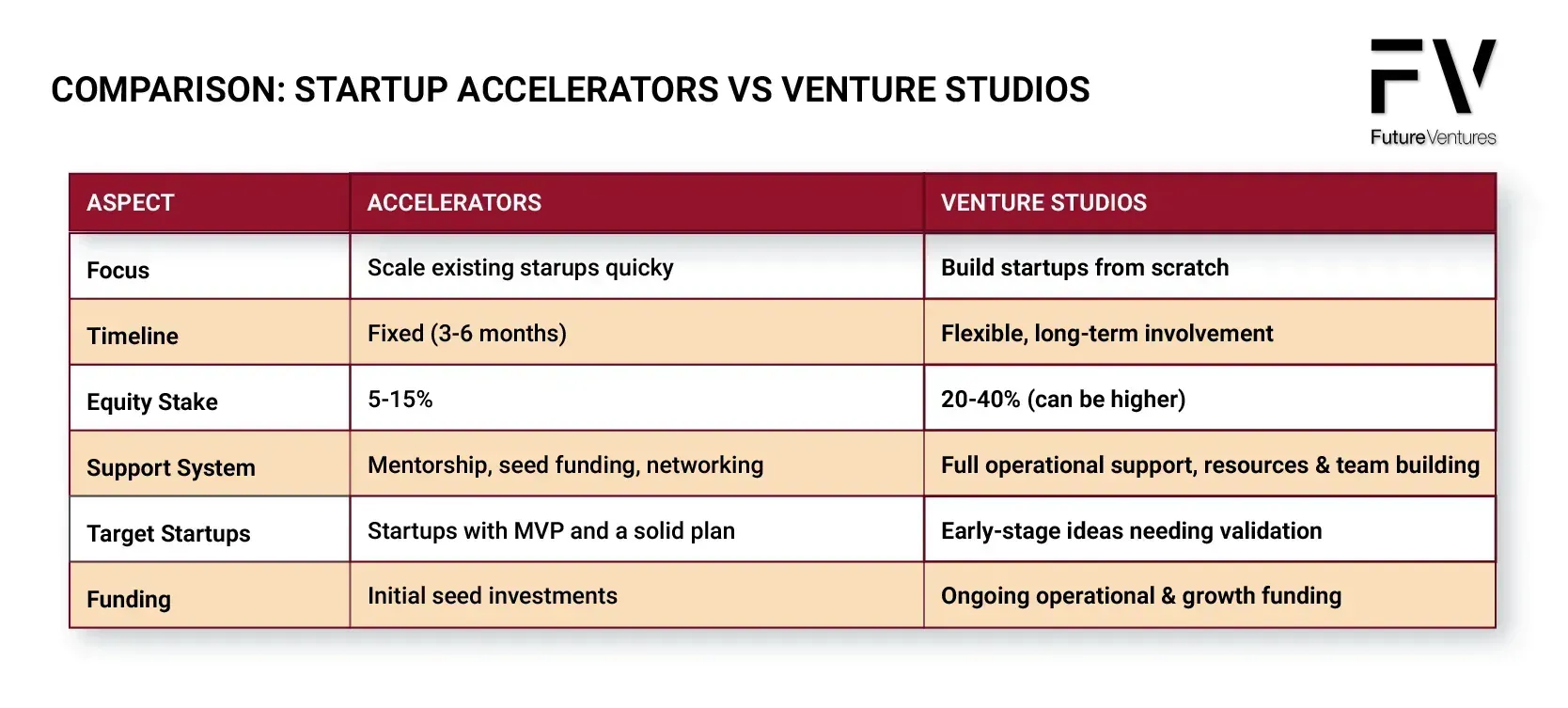
| Aspect | Accelerators | Venture Studios |
|---|---|---|
| Focus | Scale existing startups quickly | Build startups from scratch |
| Timeline | Fixed (3-6 months) | Flexible, long-term involvement |
| Equity Stake | 5-15% | 20-40% (can be higher) |
| Support System | Mentorship, seed funding, networking | Full operational support, resources & team building |
| Target Startups | Startups with a MVP and a solid plan | Early-stage ideas needing validation |
| Funding | Initial seed investments | Ongoing operational & growth funding |
| Time to Series A | Typically 56 months from founding | 25.2 months from founding |
| Success Rate | Industry standard | 30% higher than traditional startups |
| Average IRR | 21.3% | 53% |
| Approach | Educational and advisory | Hands-on and operational |
| Decision Making | Founder autonomy with guidance | Collaborative with studio involvement |
| Team Building | Minimal support | Active recruitment and development |
Joining a startup incubator also offers essential resources, mentorship, and community support to entrepreneurs at the start of their business journey, providing valuable learning opportunities and access to a supportive network.
Understanding these fundamental differences will help you determine which model aligns best with your startup’s needs, your personal working style, and your long-term vision for growth and success.
Venture capital firms play a crucial role in funding startup incubators and company builders, providing capital in exchange for equity to support the development of early-stage companies. Additionally, incubators may help founders build their initial advisory boards, offering strategic guidance and connections that are invaluable during the formative stages of a startup.
Choosing between a venture studio and an accelerator isn't just about resources—it's about finding a company-building philosophy that fits your vision, skills, and goals. Data shows venture studios have a 30% higher success rate and a 53% IRR compared to 21.3% for accelerators, though they require more equity.
Consider the following:
The startup landscape has evolved beyond a one-size-fits-all model. Your best choice aligns with your business needs and personal entrepreneurial style.
Whether you opt for the accelerator's speed or the venture studio's comprehensive support, success.
If you are ready to launch your startup, contact us: we can help you.
Learn how seed strapping can fuel your startup's growth. Discover practical strategies and insights to navigate this crucial funding stage. Read more!
Learn how the Lehman scale sets M&A and capital-raising success fees: the Lehman formula, Double Lehman, modern variations and what founders should negotiate.
Explore the J Curve's implications for investors and strategists, balancing risks and rewards. Gain insights to enhance your decision-making—read more now!
Learn practical strategies to overcome common challenges as a first-time fund manager. Dive into our guide for essential tips and insights. Read more!
MIT found 95% of AI pilots fail. See how companies use AI to improve client workflows — and why integration decides the winners.
Discover how the CEO of the future is transforming business leadership and driving change. Read the article to learn more about this emerging role.
Quality of Earnings (QoE): understand what buyers and investors look for, uncover red flags, and boost valuation before your exit.
Maximize your productivity with our CEO time management template. Learn strategies to structure your day effectively. Read more for practical insights!
How founders use a 90-day execution sprint to turn strategy into results: set quarterly priorities, align the team and keep everyone accountable for progress.
Discover key insights on investor perceptions when founders become defensive. Learn tips to navigate tough conversations effectively. Read the article now!